

EN
Padel
Opening a padel club: a reverse schedule from idea to opening day
Permits, financing, construction, software, pre-sales: a month-by-month reverse schedule for a padel club project, with the lead times to plan for.

A padel club doesn't open on the date you hope for, but on the date dictated by the longest lead times. Building permits, financing, court manufacturing: every single stage depends on the previous one, and a few weeks' delay early on can push back your opening by several months.
Backward scheduling means starting from your target opening date and working backward, step by step. In this guide, we break down the key stages of an indoor padel club project, the regulatory timelines you need to know, and the critical milestones to hit at each phase to ensure you open on schedule.
Key Takeaways
For a newly built or converted indoor club, expect a timeline of over a year from initial concept to opening day. Planning permissions represent the longest and most rigid phase of the project.
Standard building permit reviews take 3 months, extending to 5 months for commercial sports facilities open to the public (ERP). You must then factor in a 2-month public notice period during which third-party appeals can be lodged.
Court installation is fast (a few days per court once the concrete slab is ready), but court manufacturing and the surrounding facility build take several months.
Select your club management software around 6 months prior to launch: this gives you the operational runway to sell memberships and court packages before day one.
Apply for your public opening authorization at least one month before your target launch date if your facility is subject to this requirement.
How Long Does It Take to Open a Padel Club?
It all depends on your starting point. Installing outdoor courts on land you already own is far quicker than building an indoor facility from scratch. A leading padel court builder estimates that a court installation project takes an average of 6 to 9 months, including administrative procedures and workshop manufacturing. For an indoor club, you also need to factor in site sourcing, financing, and building construction.
The timeline below outlines an 18-month roadmap for a multi-court indoor club. Adapt it to your specific project: some phases will run in parallel, while others can be streamlined if you are repurposing an existing building.

Read more: Opening a Padel Club in 2026: The Complete Guide, breaking down every critical step in detail.
Phase 1 (Months T-18 to T-15): Project Validation
Before committing any capital, make sure your business model is rock-solid:
Market research: local competitive landscape, pricing benchmarks, target player demographics, and peak-hour court occupancy rates at neighboring clubs.
Facility concept: indoor vs. outdoor courts, total court count, ancillary services (pro shop, bar/restaurant, padel academy), and staffed vs. autonomous club access.
Financial projections: CapEx, projected revenue streams, and break-even point. Our padel project simulator provides realistic baseline figures in minutes.
Your court count drives everything else: required footprint, capital expenditure, and regulatory permits. Our article How Many Padel Courts Do You Need to Be Profitable? helps you find the right balance.
Phase 2 (Months T-15 to T-12): Securing the Site or Building
Once you have identified the ideal location, the goal is to secure it without fully committing until permits and financing are approved. In practice, this is handled through a conditional purchase agreement or commercial lease with conditions precedent, drafted by your legal counsel.
This is also the time to audit zoning and local planning regulations. An operational zoning certificate confirms whether your sports facility project is viable on the plot. Processing typically takes 2 months.
Phase 3 (Months T-12 to T-7): Planning Permissions, the Longest Phase
This stage sets the tempo for the entire project, as regulatory timelines are non-negotiable.
Prior Notice or Full Building Permit?
According to court manufacturers, an uncovered outdoor court typically requires a prior declaration of works, whereas an indoor or semi-covered court with over 20 m² of structure requires a full building permit. The exact rules depend on your project scope and local planning frameworks (PLU): confirm the requirements with your local planning department before submitting your application.
Expected Timelines
Building permit review: 3 months from the submission of a complete file, and 4 months in protected heritage zones.
Public access facility (ERP): When the permit covers works for a public sports facility subject to authorization, the statutory review period extends to 5 months (under Article R*423-28 of the French Urban Planning Code).
Third-party appeals: Once granted, the permit must be officially posted on-site. A 2-month legal challenge period applies from the first day of continuous on-site notice.
An incomplete application resets the clock: the local planning authority can request missing documents, and the review period only begins once the file is fully complete. Have your architect or master builder review the entire application before submission.

Phase 4 (Months T-12 to T-6): Finalizing Financing
Financing runs in parallel with planning permissions. Your bank will require a robust business plan with realistic occupancy rate assumptions, and approval is often conditional on securing the building permit.
Prepare your loan application as soon as the project concept is validated, so that your credit approval aligns with planning clearance. Our guide Padel Club Business Plan: How to Convince Your Bank outlines exactly what lenders look for.
Operating on a tight budget? A 24/7 unstaffed setup can dramatically optimize your overhead: check out our guide to autonomous padel courts.
Phase 5 (Months T-8 to T-2): Construction and Court Installation
It is important to distinguish between court assembly and the broader building construction:
Court assembly is fast. According to Padel Addict, installing a court (metal frame, glass panels, turf, and net systems) takes 4 to 5 days, excluding the concrete slab, with a specialized crew of 3 to 4 technicians. Manufacturers generally estimate about a month of on-site assembly once mobilized.
Manufacturing of steel structures and tempered glass occurs off-site. Confirm lead times with your court builder at the quoting stage, and place your order the moment permits and financing are greenlit.
Building construction (foundations, reinforced slab, roofing, lighting, locker rooms, reception area) is consistently the most time-consuming phase.
Secure a binding schedule from your contractor covering fabrication, delivery, and installation milestones, and build in a contingency buffer for weather delays if outdoor works are involved.
Phase 6 (Around Month T-6): Choosing Your Club Management Software
Many club operators wait until the final weeks after construction is completed to pick their booking software. That is too late to maximize revenue:
Presales: To sell memberships and multi-session packs before opening day, your online booking engine and payment gateway must already be fully operational.
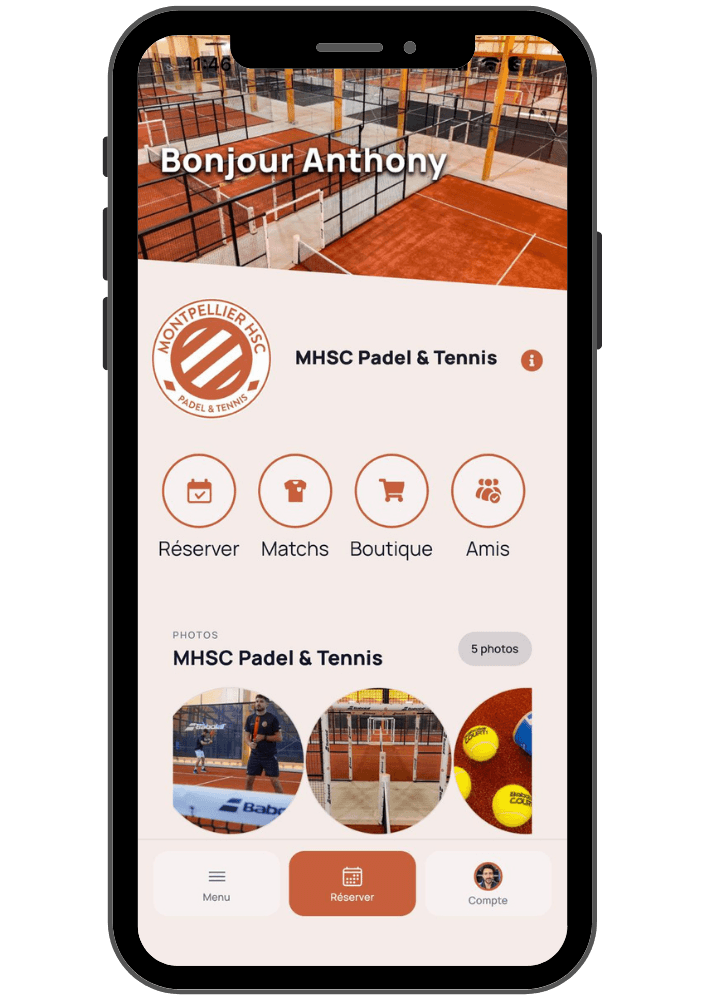
Website and mobile app: Your future community needs to download your branded app, set up player profiles, and explore your club well before opening day.
System configuration: Court booking schedules, peak/off-peak pricing tiers, membership models, and cancellation policies take time to optimize—do not leave this to opening eve.
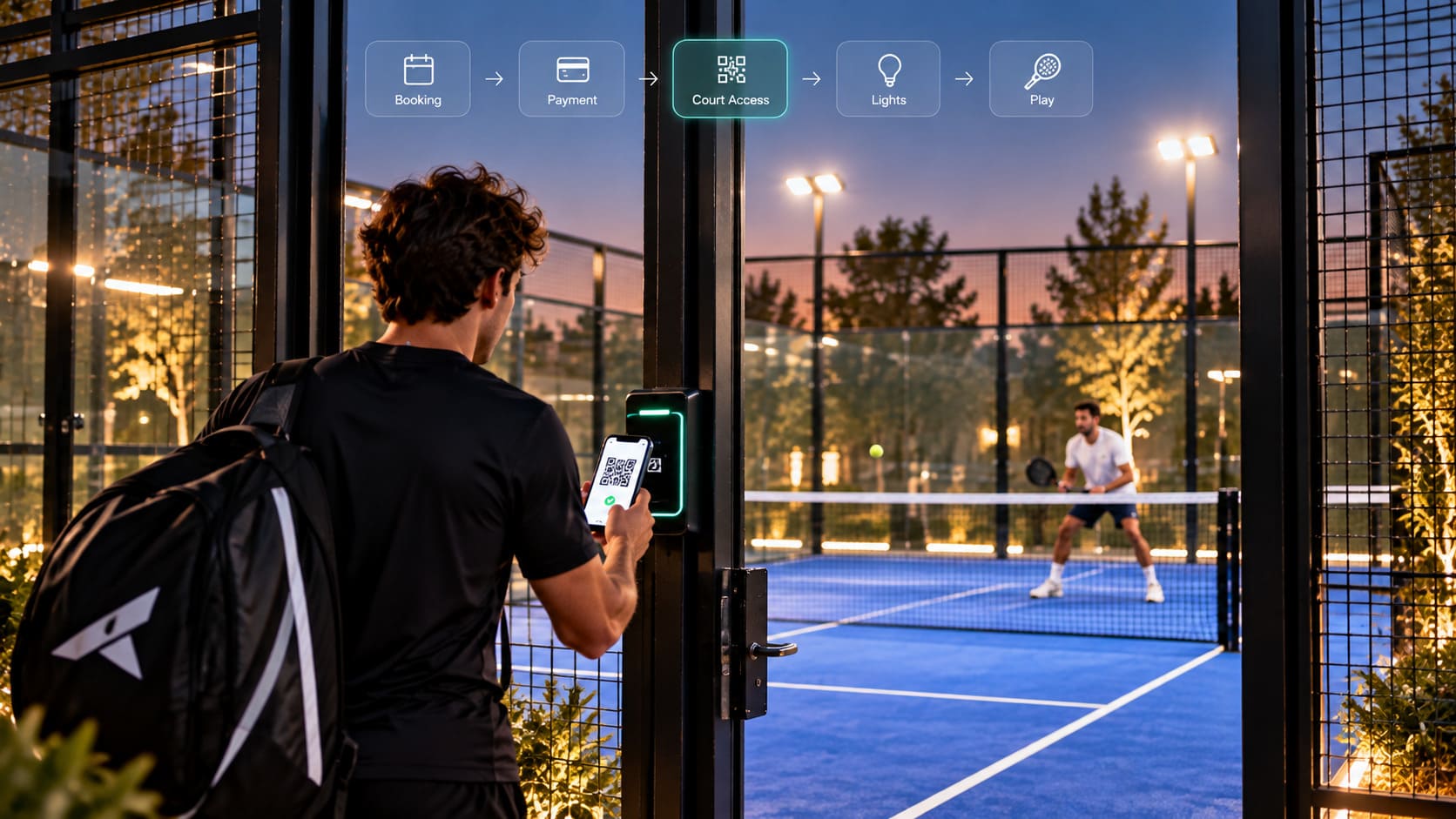
Access control: If you plan to run automated or unstaffed hours, access hardware (smart locks, QR code scanners, automated lighting) must be deployed and thoroughly tested ahead of time. Discover how access control works in a padel club.
Phase 7 (Months T-4 to T-1): Preparing Your Launch Campaign
Use the final months to drive court bookings and membership sales before your doors even open.
Set your pricing grid: peak hours, off-peak rates, member discounts. Our guide How Much to Charge for an Hour of Padel? will help you build a profitable pricing structure.
Launch presales: memberships, prepaid credit wallets, or exclusive early-bird founder passes. Explore membership pricing strategies for padel clubs.
Execute your marketing plan: social media marketing, Google Business Profile optimization, partnerships with local businesses and sports organizations, and launch events.
Onboard your team: staff recruitment, shift scheduling, software training, and daily opening/closing SOPs.
Public Opening Authorization
An indoor padel center is classified as a public access sports facility (Type X ERP in France). It falls under Category 5 if it accommodates up to 200 people across all levels; larger capacities fall into higher regulatory tiers.
Following construction or renovation, operators must submit a formal opening request to local authorities (the Mayor's office or Prefecture), which issues an official operating decree following approval by safety and accessibility inspectors. This application must be submitted more than one month before your scheduled opening date. Category 5 facilities without accommodation benefit from streamlined requirements: confirm the specific process with your local municipality.

Phase 8 (Opening to Month M+3): Managing the Early Weeks
Opening day is not the finish line. The first quarter will validate whether your business assumptions hold true:
Track weekly court occupancy rates by time slot, closely analyzing peak vs. off-peak performance.
Optimize underperforming time slots with daytime discounts, social mixers, and group coaching clinics. Learn how to boost court occupancy in your padel club.
Host your inaugural tournament to foster community and drive player retention: read how to organize a padel tournament at your club.
5 Common Pitfalls That Delay Opening Dates
Announcing a launch date before submitting planning permissions. Until review periods and third-party appeal windows have passed, any target date is pure speculation.
Submitting an incomplete permit application. Every missing document restarts the statutory review clock.
Ordering courts too late. On-site assembly is quick, but structural manufacturing and logistics require significant lead times.
Choosing software at the final hour. You forfeit presales opportunities and rush system setup, risking poor customer experiences from day one.
Overlooking opening authorization. If your facility requires safety commission sign-off, applications must be submitted at least a month in advance.
Launch Your Padel Club with Doinsport
From software implementation to accelerating business growth, the Doinsport team supports sports venue operators at every stage:
Tailored onboarding: We configure Doinsport to match your club's operational model, pricing rules, and memberships (custom booking engine, payment setup, subscription tiers).
Team training: We train your staff so your club runs smoothly and autonomously from day one, backed by responsive post-launch customer support.
Club growth consulting: Beyond club management software, we share industry best practices to help you optimize court occupancy, maximize revenue, and build a thriving player community.
Related resources: The Doinsport Implementation Experience and our free guide How to Launch a Successful Padel Facility.

Is your club project underway? Let's talk about your launch →
Frequently Asked Questions
How long does it take to open a padel club?
It largely depends on your project scope. Court manufacturers estimate that a standalone court installation project averages 6 to 9 months, including permits and workshop fabrication. For an indoor facility requiring site acquisition, debt financing, planning permissions, and structural works, expect the timeline to exceed 12 months.
Do you need a building permit for a padel court?
Indoor and covered courts typically require a full building permit, whereas outdoor uncovered courts often only require a prior declaration of works. Exact requirements depend on facility dimensions and local zoning plans (PLU): consult your local municipal planning office to confirm.
How long does building permit processing take?
Typically 3 months, 4 months in conservation zones, and 5 months for commercial sports facilities open to the public (ERP). You must also factor in a mandatory 2-month on-site notice period to allow for potential third-party appeals.
When should you start selling club memberships?
As soon as your pricing tiers are locked down and your online payment system is active—ideally 3 to 4 months before your doors open. Presales generate upfront cash flow and ensure courts are booked from day one.
When should you choose your court booking software?
Approximately 6 months before opening. This gives you ample time to configure schedules, rates, and memberships, launch your branded website and mobile app, and roll out pre-launch marketing campaigns.
Is a padel club considered a public access facility (ERP)?
Yes. An indoor padel facility is classified as a public sports building (Type X ERP under French regulations), falling into Category 5 for capacities of up to 200 occupants across all levels.
A padel club doesn't open on the date you hope for, but on the date dictated by the longest lead times. Building permits, financing, court manufacturing: every single stage depends on the previous one, and a few weeks' delay early on can push back your opening by several months.
Backward scheduling means starting from your target opening date and working backward, step by step. In this guide, we break down the key stages of an indoor padel club project, the regulatory timelines you need to know, and the critical milestones to hit at each phase to ensure you open on schedule.
Key Takeaways
For a newly built or converted indoor club, expect a timeline of over a year from initial concept to opening day. Planning permissions represent the longest and most rigid phase of the project.
Standard building permit reviews take 3 months, extending to 5 months for commercial sports facilities open to the public (ERP). You must then factor in a 2-month public notice period during which third-party appeals can be lodged.
Court installation is fast (a few days per court once the concrete slab is ready), but court manufacturing and the surrounding facility build take several months.
Select your club management software around 6 months prior to launch: this gives you the operational runway to sell memberships and court packages before day one.
Apply for your public opening authorization at least one month before your target launch date if your facility is subject to this requirement.
How Long Does It Take to Open a Padel Club?
It all depends on your starting point. Installing outdoor courts on land you already own is far quicker than building an indoor facility from scratch. A leading padel court builder estimates that a court installation project takes an average of 6 to 9 months, including administrative procedures and workshop manufacturing. For an indoor club, you also need to factor in site sourcing, financing, and building construction.
The timeline below outlines an 18-month roadmap for a multi-court indoor club. Adapt it to your specific project: some phases will run in parallel, while others can be streamlined if you are repurposing an existing building.
Read more: Opening a Padel Club in 2026: The Complete Guide, breaking down every critical step in detail.
Phase 1 (Months T-18 to T-15): Project Validation
Before committing any capital, make sure your business model is rock-solid:
Market research: local competitive landscape, pricing benchmarks, target player demographics, and peak-hour court occupancy rates at neighboring clubs.
Facility concept: indoor vs. outdoor courts, total court count, ancillary services (pro shop, bar/restaurant, padel academy), and staffed vs. autonomous club access.
Financial projections: CapEx, projected revenue streams, and break-even point. Our padel project simulator provides realistic baseline figures in minutes.
Your court count drives everything else: required footprint, capital expenditure, and regulatory permits. Our article How Many Padel Courts Do You Need to Be Profitable? helps you find the right balance.
Phase 2 (Months T-15 to T-12): Securing the Site or Building
Once you have identified the ideal location, the goal is to secure it without fully committing until permits and financing are approved. In practice, this is handled through a conditional purchase agreement or commercial lease with conditions precedent, drafted by your legal counsel.
This is also the time to audit zoning and local planning regulations. An operational zoning certificate confirms whether your sports facility project is viable on the plot. Processing typically takes 2 months.
Phase 3 (Months T-12 to T-7): Planning Permissions, the Longest Phase
This stage sets the tempo for the entire project, as regulatory timelines are non-negotiable.
Prior Notice or Full Building Permit?
According to court manufacturers, an uncovered outdoor court typically requires a prior declaration of works, whereas an indoor or semi-covered court with over 20 m² of structure requires a full building permit. The exact rules depend on your project scope and local planning frameworks (PLU): confirm the requirements with your local planning department before submitting your application.
Expected Timelines
Building permit review: 3 months from the submission of a complete file, and 4 months in protected heritage zones.
Public access facility (ERP): When the permit covers works for a public sports facility subject to authorization, the statutory review period extends to 5 months (under Article R*423-28 of the French Urban Planning Code).
Third-party appeals: Once granted, the permit must be officially posted on-site. A 2-month legal challenge period applies from the first day of continuous on-site notice.
An incomplete application resets the clock: the local planning authority can request missing documents, and the review period only begins once the file is fully complete. Have your architect or master builder review the entire application before submission.
Phase 4 (Months T-12 to T-6): Finalizing Financing
Financing runs in parallel with planning permissions. Your bank will require a robust business plan with realistic occupancy rate assumptions, and approval is often conditional on securing the building permit.
Prepare your loan application as soon as the project concept is validated, so that your credit approval aligns with planning clearance. Our guide Padel Club Business Plan: How to Convince Your Bank outlines exactly what lenders look for.
Operating on a tight budget? A 24/7 unstaffed setup can dramatically optimize your overhead: check out our guide to autonomous padel courts.
Phase 5 (Months T-8 to T-2): Construction and Court Installation
It is important to distinguish between court assembly and the broader building construction:
Court assembly is fast. According to Padel Addict, installing a court (metal frame, glass panels, turf, and net systems) takes 4 to 5 days, excluding the concrete slab, with a specialized crew of 3 to 4 technicians. Manufacturers generally estimate about a month of on-site assembly once mobilized.
Manufacturing of steel structures and tempered glass occurs off-site. Confirm lead times with your court builder at the quoting stage, and place your order the moment permits and financing are greenlit.
Building construction (foundations, reinforced slab, roofing, lighting, locker rooms, reception area) is consistently the most time-consuming phase.
Secure a binding schedule from your contractor covering fabrication, delivery, and installation milestones, and build in a contingency buffer for weather delays if outdoor works are involved.
Phase 6 (Around Month T-6): Choosing Your Club Management Software
Many club operators wait until the final weeks after construction is completed to pick their booking software. That is too late to maximize revenue:
Presales: To sell memberships and multi-session packs before opening day, your online booking engine and payment gateway must already be fully operational.
Website and mobile app: Your future community needs to download your branded app, set up player profiles, and explore your club well before opening day.
System configuration: Court booking schedules, peak/off-peak pricing tiers, membership models, and cancellation policies take time to optimize—do not leave this to opening eve.
Access control: If you plan to run automated or unstaffed hours, access hardware (smart locks, QR code scanners, automated lighting) must be deployed and thoroughly tested ahead of time. Discover how access control works in a padel club.
Phase 7 (Months T-4 to T-1): Preparing Your Launch Campaign
Use the final months to drive court bookings and membership sales before your doors even open.
Set your pricing grid: peak hours, off-peak rates, member discounts. Our guide How Much to Charge for an Hour of Padel? will help you build a profitable pricing structure.
Launch presales: memberships, prepaid credit wallets, or exclusive early-bird founder passes. Explore membership pricing strategies for padel clubs.
Execute your marketing plan: social media marketing, Google Business Profile optimization, partnerships with local businesses and sports organizations, and launch events.
Onboard your team: staff recruitment, shift scheduling, software training, and daily opening/closing SOPs.
Public Opening Authorization
An indoor padel center is classified as a public access sports facility (Type X ERP in France). It falls under Category 5 if it accommodates up to 200 people across all levels; larger capacities fall into higher regulatory tiers.
Following construction or renovation, operators must submit a formal opening request to local authorities (the Mayor's office or Prefecture), which issues an official operating decree following approval by safety and accessibility inspectors. This application must be submitted more than one month before your scheduled opening date. Category 5 facilities without accommodation benefit from streamlined requirements: confirm the specific process with your local municipality.
Phase 8 (Opening to Month M+3): Managing the Early Weeks
Opening day is not the finish line. The first quarter will validate whether your business assumptions hold true:
Track weekly court occupancy rates by time slot, closely analyzing peak vs. off-peak performance.
Optimize underperforming time slots with daytime discounts, social mixers, and group coaching clinics. Learn how to boost court occupancy in your padel club.
Host your inaugural tournament to foster community and drive player retention: read how to organize a padel tournament at your club.
5 Common Pitfalls That Delay Opening Dates
Announcing a launch date before submitting planning permissions. Until review periods and third-party appeal windows have passed, any target date is pure speculation.
Submitting an incomplete permit application. Every missing document restarts the statutory review clock.
Ordering courts too late. On-site assembly is quick, but structural manufacturing and logistics require significant lead times.
Choosing software at the final hour. You forfeit presales opportunities and rush system setup, risking poor customer experiences from day one.
Overlooking opening authorization. If your facility requires safety commission sign-off, applications must be submitted at least a month in advance.
Launch Your Padel Club with Doinsport
From software implementation to accelerating business growth, the Doinsport team supports sports venue operators at every stage:
Tailored onboarding: We configure Doinsport to match your club's operational model, pricing rules, and memberships (custom booking engine, payment setup, subscription tiers).
Team training: We train your staff so your club runs smoothly and autonomously from day one, backed by responsive post-launch customer support.
Club growth consulting: Beyond club management software, we share industry best practices to help you optimize court occupancy, maximize revenue, and build a thriving player community.
Related resources: The Doinsport Implementation Experience and our free guide How to Launch a Successful Padel Facility.
Is your club project underway? Let's talk about your launch →
Frequently Asked Questions
How long does it take to open a padel club?
It largely depends on your project scope. Court manufacturers estimate that a standalone court installation project averages 6 to 9 months, including permits and workshop fabrication. For an indoor facility requiring site acquisition, debt financing, planning permissions, and structural works, expect the timeline to exceed 12 months.
Do you need a building permit for a padel court?
Indoor and covered courts typically require a full building permit, whereas outdoor uncovered courts often only require a prior declaration of works. Exact requirements depend on facility dimensions and local zoning plans (PLU): consult your local municipal planning office to confirm.
How long does building permit processing take?
Typically 3 months, 4 months in conservation zones, and 5 months for commercial sports facilities open to the public (ERP). You must also factor in a mandatory 2-month on-site notice period to allow for potential third-party appeals.
When should you start selling club memberships?
As soon as your pricing tiers are locked down and your online payment system is active—ideally 3 to 4 months before your doors open. Presales generate upfront cash flow and ensure courts are booked from day one.
When should you choose your court booking software?
Approximately 6 months before opening. This gives you ample time to configure schedules, rates, and memberships, launch your branded website and mobile app, and roll out pre-launch marketing campaigns.
Is a padel club considered a public access facility (ERP)?
Yes. An indoor padel facility is classified as a public sports building (Type X ERP under French regulations), falling into Category 5 for capacities of up to 200 occupants across all levels.
Similar articles
Oct 28, 2026
Unlimited off-peak, discount memberships, packs and wallets: the membership plans padel clubs offer in 2026, their prices and how to set yours.

Oct 22, 2026
How much should you charge per hour for padel? 2026 market rates, peak vs. off-peak pricing, and memberships: the complete guide to setting your club's rates.

Oct 14, 2026
How Does Access Control Work for Padel Clubs? QR Codes, RFID, Smart Locks, Court Lighting, and Bookings Explained.
See Doinsport in action
Ready to grow your padel or tennis club?
Join over 1,000 clubs that run on Doinsport. Book a free demo and see what it can do for your club.
We're here to help.


See Doinsport in action
Ready to grow your padel or tennis club?
Join over 1,000 clubs that run on Doinsport. Book a free demo and see what it can do for your club.
See Doinsport in action
Ready to grow your padel or tennis club?
Join over 1,000 clubs that run on Doinsport. Book a free demo and see what it can do for your club.
We're here to help.