

EN
EN
Padel
Padel Club Business Plan: The Complete Guide to Securing Bank Financing
The complete padel business plan structure to win over your bank in 2026: methodology, key figures, and a free tool to build your financial forecast.

Methodology · Structure · Key figures · Mistakes to avoid
Why a strong business plan is non-negotiable when opening a padel club
Padel is booming. France will have more than 1,000 clubs by 2026, and demand continues to far outpace supply. But that momentum alone is not enough to convince a bank to approve your loan.
Opening a padel club requires between €250,000 and €500,000 in initial investment. No one will lend you that amount on the basis of a verbal pitch and a rough Excel file. Your business plan is the document that turns your vision into a fundable project.
And in 2026, banks are much more demanding than they were two years ago: they have reviewed hundreds of padel applications, and they know what works and what fails. A generic business plan will no longer cut it.
Here is the full methodology for building a solid application — the one that gets you approved.
The structure of a padel club business plan that wins approval
A strong padel business plan is built around 7 key sections. The order matters just as much as the content.
1. Executive Summary (1 page maximum)
This is the first — and sometimes the only — page your banker will read in detail. It must make them want to turn to the next page.
What it should include:
The project in one sentence ("Opening a 4-court indoor padel club in [City]")
The target market and its local potential
The total investment amount and funding split (equity / loan)
Projected revenue over 3 years
The break-even point and payback period
This page is written last — once everything else is locked in.
2. Founder and team overview
Banks finance people as much as they finance projects. This section should reassure them about:
Your professional background and skill set
Your connection to sport and padel
Your personal investment (proof of skin in the game)
The team structure: partners, first planned hires, advisors
If you have never come from the sports world, that is not a deal-breaker — but you must then show how you compensate through an operational partner or an experienced business coach.
3. Market research — local and data-driven
This is where most applications fall apart. A generic market study about "padel in France" is no longer enough. Your banker wants to know: why will your club, in this exact location, capture local demand?
The essential elements:
Local demand — how many potential players are there within a 15 km radius? What is the density of higher-income households? Are there businesses that can generate team-building traffic?
Existing competition — list the competing clubs within a 20 km radius. How many courts does each have? Indoor or outdoor? Pricing? Observable occupancy rate (try booking their evening and weekend slots to gauge saturation)?
Positioning — where do you fit? Premium? Community-led? Family-oriented? Competitive? Your concept should address a clearly identified gap in the local offer.
Precise target audience — not "padel enthusiasts" but: "professionals aged 30-50, higher-income households within a 20-minute drive, regular players looking for available evening slots on weekdays, frustrated by the saturation of existing clubs".
4. Offer and concept description
This section explains what your club will actually deliver:
The number and type of courts (indoor / outdoor / hybrid)
Associated services (coaching, tournaments, bar, shop, changing rooms, parking)
Opening hours (and their impact on occupancy)
The differentiating customer experience (mobile app, 24/7 access control, loyalty programme)
Any premium services (clubhouse, high-level coaching, corporate partnerships)
A founder who only offers "4 padel courts" is less credible than one who presents a clear concept with a well-thought-out customer journey.
5. Marketing and sales strategy
How will you fill your courts from day one? How will you retain members? How will you drive acquisition?
The levers to detail:
Pre-launch strategy (3 months before opening)
Founding members programme (pricing offer + exclusive benefits)
Digital presence (Google My Business, Instagram, local Facebook pages, sports influencer partnerships)
Local partnerships (sports clubs, employee committees, schools, city councils)
Tournaments and events programme to energise the community
Retention strategy (memberships, referrals, preferred pricing)
A bank wants to see how you will generate traffic — not just how much you expect to generate.
6. Financial forecast — the core of the application
This is the most closely reviewed and most demanding section. It includes several documents:
Initial investment plan — a full breakdown of costs: courts (budget at least €50,000 per court), building, changing rooms, bar, equipment, legal and administrative fees, start-up cash.
Funding plan — how much personal equity? How much borrowed? What grants may be available (National Sports Agency, FFT)?
3-year projected income statement — revenue, fixed costs, variable costs, EBITDA, net profit, month by month for the first year.
24-month cash flow forecast — this is what the banker looks at first. If you go cash-negative in month 8, your application will likely be rejected.
Break-even analysis — at what occupancy rate does your club become profitable?
Payback period — typically between 2 and 5 years for a well-managed padel club.
To build these projections, you need a reliable simulation tool — more on that below.
7. Appendices — credibility in the details
Quotes from court builders
Heads of terms or commercial lease
Site survey or preliminary diagnostics
CVs of the founders
Letters of intent from partners (businesses, sponsors)
Third-party market studies supporting your assumptions
The key market figures to include in your business plan
To give your projections credibility, rely on market benchmarks:
Investment per court: between €50,000 and €80,000 for a new indoor court
Average revenue per court: around €80,000 per year in a well-run club
Average occupancy rate: 50% to 60% in established clubs, 30% to 45% in year one
Net margin: 13% to 20% of revenue once the club is mature
Break-even timeline: 2 to 5 years depending on the setup and location
Average hourly rate: between €25 and €35 depending on the time slot and geographic area
These benchmarks are averages — your project may be above or below them, but you must justify every deviation.
The tool that radically simplifies the financial side
Building the financial forecast for a padel club manually in Excel takes several days of work — with a huge risk of calculation errors or structural omissions (miscalculated payroll taxes, seasonality not taken into account, poorly valued late-night slots, etc.).
To save time and make your projections more reliable, use the Doinsport padel profitability simulator — a 100% free tool that calculates in just a few minutes:
Your detailed total investment
Your monthly and annual revenue across 3 scenarios (conservative / realistic / ambitious)
Your detailed costs
Your break-even point
Your payback period
Your estimated operating margin
The simulator results can be directly included in your business plan — it is an excellent starting point that you can then refine with your accountant or advisor.
👉 Try the padel profitability simulator
The 5 mistakes that get a padel business plan rejected
Mistake #1 — Overestimating occupancy from opening day On average, it takes a club 6 to 12 months to reach full operating rhythm. Projecting 65% occupancy from month 1 is a red flag for an experienced banker.
Mistake #2 — Underestimating start-up cash Always budget 3 to 6 months of fixed costs as a reserve. A profitable project can collapse within a few months for lack of cash.
Mistake #3 — Neglecting payroll and tax costs Many business plans show "gross salaries" without employer contributions (often +40%). Your real costs are therefore massively understated.
Mistake #4 — Forgetting seasonality An outdoor club does not generate the same revenue in July-August as it does in January-February. An indoor club also has its own seasonality (back-to-school = peak, summer = low point). Model it month by month.
Mistake #5 — Presenting only one scenario A credible business plan always includes 3 scenarios: conservative, realistic, ambitious. The banker wants to see that you have thought through difficult situations — not just optimism.
How to manage your club once it is open
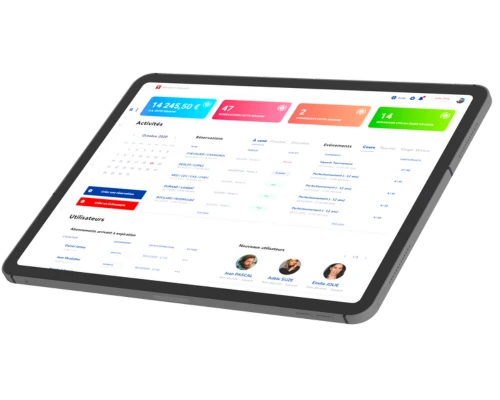
A business plan is a forecasting document. But once the club is open, you will need a tool to manage in real time: occupancy by time slot, revenue by source, coach performance, retention rate, consolidated financial KPIs.
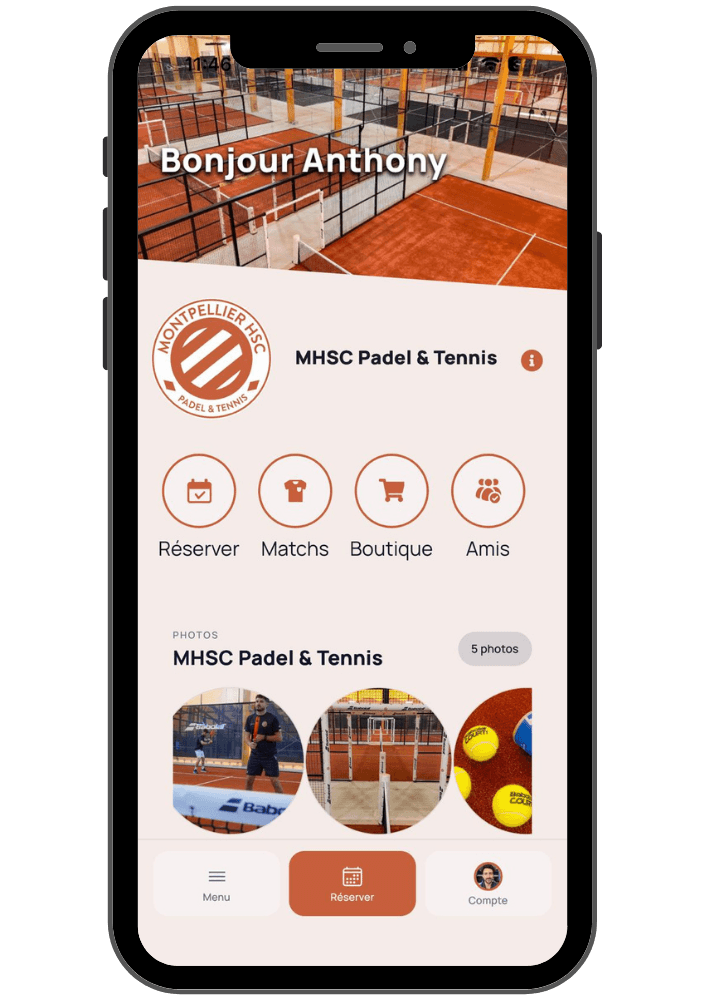
That is exactly what the Doinsport management platform offers — the all-in-one solution used by more than 1,000 clubs in France to run their business. 24/7 booking through a white-label mobile app, membership management, tournaments, access control, real-time statistics: everything a club owner needs at their fingertips to optimise occupancy and deliver the results forecast in the business plan.
FAQ — Padel club business plan
How many pages should a padel business plan be? Plan for 25 to 40 pages in total: around ten for the narrative section, the rest for the financial appendices. A dossier that is too short lacks credibility; one that is too long loses the banker.
Should you use a chartered accountant for your business plan? Recommended. A chartered accountant experienced in financing applications will know how to structure the financial section in line with bank expectations. Budget €1,500 to €3,500 for full support.
Can you submit a business plan without having signed the premises? Yes — you can present a conditional agreement subject to financing approval. That is even the standard process.
What minimum personal equity do banks usually require? Between 20% and 30% of the total project is generally expected. Below that, the application becomes difficult to approve. Equity may include grants (ANS, FFT) if they have already been secured.
Should you present the same business plan to several banks? Yes — it is strongly recommended. Put at least 3 lenders in competition to secure the best loan terms. Prepare a short version (10 pages + executive summary) for the first discussions.
Ready to structure your business plan?
Building a strong padel business plan is rigorous work, but it is manageable if you follow the methodology in this article. The financial section remains the most demanding — it is what determines the outcome of your application with the banks.
To move faster and make your projections more reliable, use the Doinsport padel profitability simulator — it gives you a structured first forecast in just a few minutes, which you can then refine with your advisor.
And once your club is open, Doinsport supports you every day in managing your activity and reaching the goals set out in your business plan.
Methodology · Structure · Key figures · Mistakes to avoid
Why a strong business plan is non-negotiable when opening a padel club
Padel is booming. France will have more than 1,000 clubs by 2026, and demand continues to far outpace supply. But that momentum alone is not enough to convince a bank to approve your loan.
Opening a padel club requires between €250,000 and €500,000 in initial investment. No one will lend you that amount on the basis of a verbal pitch and a rough Excel file. Your business plan is the document that turns your vision into a fundable project.
And in 2026, banks are much more demanding than they were two years ago: they have reviewed hundreds of padel applications, and they know what works and what fails. A generic business plan will no longer cut it.
Here is the full methodology for building a solid application — the one that gets you approved.
The structure of a padel club business plan that wins approval
A strong padel business plan is built around 7 key sections. The order matters just as much as the content.
1. Executive Summary (1 page maximum)
This is the first — and sometimes the only — page your banker will read in detail. It must make them want to turn to the next page.
What it should include:
The project in one sentence ("Opening a 4-court indoor padel club in [City]")
The target market and its local potential
The total investment amount and funding split (equity / loan)
Projected revenue over 3 years
The break-even point and payback period
This page is written last — once everything else is locked in.
2. Founder and team overview
Banks finance people as much as they finance projects. This section should reassure them about:
Your professional background and skill set
Your connection to sport and padel
Your personal investment (proof of skin in the game)
The team structure: partners, first planned hires, advisors
If you have never come from the sports world, that is not a deal-breaker — but you must then show how you compensate through an operational partner or an experienced business coach.
3. Market research — local and data-driven
This is where most applications fall apart. A generic market study about "padel in France" is no longer enough. Your banker wants to know: why will your club, in this exact location, capture local demand?
The essential elements:
Local demand — how many potential players are there within a 15 km radius? What is the density of higher-income households? Are there businesses that can generate team-building traffic?
Existing competition — list the competing clubs within a 20 km radius. How many courts does each have? Indoor or outdoor? Pricing? Observable occupancy rate (try booking their evening and weekend slots to gauge saturation)?
Positioning — where do you fit? Premium? Community-led? Family-oriented? Competitive? Your concept should address a clearly identified gap in the local offer.
Precise target audience — not "padel enthusiasts" but: "professionals aged 30-50, higher-income households within a 20-minute drive, regular players looking for available evening slots on weekdays, frustrated by the saturation of existing clubs".
4. Offer and concept description
This section explains what your club will actually deliver:
The number and type of courts (indoor / outdoor / hybrid)
Associated services (coaching, tournaments, bar, shop, changing rooms, parking)
Opening hours (and their impact on occupancy)
The differentiating customer experience (mobile app, 24/7 access control, loyalty programme)
Any premium services (clubhouse, high-level coaching, corporate partnerships)
A founder who only offers "4 padel courts" is less credible than one who presents a clear concept with a well-thought-out customer journey.
5. Marketing and sales strategy
How will you fill your courts from day one? How will you retain members? How will you drive acquisition?
The levers to detail:
Pre-launch strategy (3 months before opening)
Founding members programme (pricing offer + exclusive benefits)
Digital presence (Google My Business, Instagram, local Facebook pages, sports influencer partnerships)
Local partnerships (sports clubs, employee committees, schools, city councils)
Tournaments and events programme to energise the community
Retention strategy (memberships, referrals, preferred pricing)
A bank wants to see how you will generate traffic — not just how much you expect to generate.
6. Financial forecast — the core of the application
This is the most closely reviewed and most demanding section. It includes several documents:
Initial investment plan — a full breakdown of costs: courts (budget at least €50,000 per court), building, changing rooms, bar, equipment, legal and administrative fees, start-up cash.
Funding plan — how much personal equity? How much borrowed? What grants may be available (National Sports Agency, FFT)?
3-year projected income statement — revenue, fixed costs, variable costs, EBITDA, net profit, month by month for the first year.
24-month cash flow forecast — this is what the banker looks at first. If you go cash-negative in month 8, your application will likely be rejected.
Break-even analysis — at what occupancy rate does your club become profitable?
Payback period — typically between 2 and 5 years for a well-managed padel club.
To build these projections, you need a reliable simulation tool — more on that below.
7. Appendices — credibility in the details
Quotes from court builders
Heads of terms or commercial lease
Site survey or preliminary diagnostics
CVs of the founders
Letters of intent from partners (businesses, sponsors)
Third-party market studies supporting your assumptions
The key market figures to include in your business plan
To give your projections credibility, rely on market benchmarks:
Investment per court: between €50,000 and €80,000 for a new indoor court
Average revenue per court: around €80,000 per year in a well-run club
Average occupancy rate: 50% to 60% in established clubs, 30% to 45% in year one
Net margin: 13% to 20% of revenue once the club is mature
Break-even timeline: 2 to 5 years depending on the setup and location
Average hourly rate: between €25 and €35 depending on the time slot and geographic area
These benchmarks are averages — your project may be above or below them, but you must justify every deviation.
The tool that radically simplifies the financial side
Building the financial forecast for a padel club manually in Excel takes several days of work — with a huge risk of calculation errors or structural omissions (miscalculated payroll taxes, seasonality not taken into account, poorly valued late-night slots, etc.).
To save time and make your projections more reliable, use the Doinsport padel profitability simulator — a 100% free tool that calculates in just a few minutes:
Your detailed total investment
Your monthly and annual revenue across 3 scenarios (conservative / realistic / ambitious)
Your detailed costs
Your break-even point
Your payback period
Your estimated operating margin
The simulator results can be directly included in your business plan — it is an excellent starting point that you can then refine with your accountant or advisor.
👉 Try the padel profitability simulator
The 5 mistakes that get a padel business plan rejected
Mistake #1 — Overestimating occupancy from opening day On average, it takes a club 6 to 12 months to reach full operating rhythm. Projecting 65% occupancy from month 1 is a red flag for an experienced banker.
Mistake #2 — Underestimating start-up cash Always budget 3 to 6 months of fixed costs as a reserve. A profitable project can collapse within a few months for lack of cash.
Mistake #3 — Neglecting payroll and tax costs Many business plans show "gross salaries" without employer contributions (often +40%). Your real costs are therefore massively understated.
Mistake #4 — Forgetting seasonality An outdoor club does not generate the same revenue in July-August as it does in January-February. An indoor club also has its own seasonality (back-to-school = peak, summer = low point). Model it month by month.
Mistake #5 — Presenting only one scenario A credible business plan always includes 3 scenarios: conservative, realistic, ambitious. The banker wants to see that you have thought through difficult situations — not just optimism.
How to manage your club once it is open
A business plan is a forecasting document. But once the club is open, you will need a tool to manage in real time: occupancy by time slot, revenue by source, coach performance, retention rate, consolidated financial KPIs.
That is exactly what the Doinsport management platform offers — the all-in-one solution used by more than 1,000 clubs in France to run their business. 24/7 booking through a white-label mobile app, membership management, tournaments, access control, real-time statistics: everything a club owner needs at their fingertips to optimise occupancy and deliver the results forecast in the business plan.
FAQ — Padel club business plan
How many pages should a padel business plan be? Plan for 25 to 40 pages in total: around ten for the narrative section, the rest for the financial appendices. A dossier that is too short lacks credibility; one that is too long loses the banker.
Should you use a chartered accountant for your business plan? Recommended. A chartered accountant experienced in financing applications will know how to structure the financial section in line with bank expectations. Budget €1,500 to €3,500 for full support.
Can you submit a business plan without having signed the premises? Yes — you can present a conditional agreement subject to financing approval. That is even the standard process.
What minimum personal equity do banks usually require? Between 20% and 30% of the total project is generally expected. Below that, the application becomes difficult to approve. Equity may include grants (ANS, FFT) if they have already been secured.
Should you present the same business plan to several banks? Yes — it is strongly recommended. Put at least 3 lenders in competition to secure the best loan terms. Prepare a short version (10 pages + executive summary) for the first discussions.
Ready to structure your business plan?
Building a strong padel business plan is rigorous work, but it is manageable if you follow the methodology in this article. The financial section remains the most demanding — it is what determines the outcome of your application with the banks.
To move faster and make your projections more reliable, use the Doinsport padel profitability simulator — it gives you a structured first forecast in just a few minutes, which you can then refine with your advisor.
And once your club is open, Doinsport supports you every day in managing your activity and reaching the goals set out in your business plan.
Similar articles
Sep 16, 2026
Découvrez comment organiser efficacement une école de tennis : inscriptions, groupes, niveaux, créneaux, paiements et suivi des élèves.

Sep 9, 2026
How to manage multiple padel clubs from a single software solution? Handle bookings, revenue, members, reporting, and a custom app for multi-site networks and franchises.

Sep 8, 2026
How to switch your tennis club management software without losing data or disrupting your members: steps, migration, and best practices.

Take your club to the next level
Ready to transform your padel, tennis, and country club?
Join the +1,000 clubs that trust Doinsport. Get started in less than 30 minutes and see the difference from the very first day.
We are here to support you.


Take your club to the next level
Ready to transform your padel, tennis, and country club?
Join the +1,000 clubs that trust Doinsport. Get started in less than 30 minutes and see the difference from the very first day.
Take your club to the next level
Ready to transform your padel, tennis, and country club?
Join the +1,000 clubs that trust Doinsport. Get started in less than 30 minutes and see the difference from the very first day.
We are here to support you.