

EN
EN
Padel
How can you increase your padel club’s court occupancy rate in 2026?
Are your courts never as full as you’d like? Discover 8 actionable levers to increase your padel club’s occupancy rate in 2026
Operational guide · 8 concrete levers · Data-driven figures
Occupancy rate, the metric that changes everything
You can have the best courts in town, a friendly team, and a welcoming clubhouse. If your slots are not filled, your club will never be profitable.
Between average revenue of €80,000 per court and occupancy above 50%, padel confirms it has become a genuine economic driver for private clubs. But behind that national average lie significant gaps: some clubs post 75% occupancy, while others struggle to get above 35%. The difference has nothing to do with luck or location alone => it comes down to how the club is managed and operated day to day.
Player satisfaction with slot availability stands at just 57% in France, the lowest-rated criterion of all. In other words: demand is there, structurally unmet. The manager's job is to capture that demand with the right tools and the right strategies.
Here are the 8 most effective levers to increase your occupancy rate in 2026.
How to calculate your occupancy rate
Before optimizing, you need to measure. The calculation is simple:
Occupancy rate = (reserved hours ÷ available hours) × 100
Example: a club with 4 courts open 14 hours a day, 7 days a week, has 392 available hours per week. If it rents 220 of them, its occupancy rate is 56%.
The classic trap is to calculate an overall rate that masks major differences by time slot. A club can show 60% overall occupancy while its evening slots are at 95% and its weekday mornings at 20%. Those empty slots are the ones you need to address first.
Lever 1: 24/7 online booking
This is the first lever, and by far the most impactful. A player who wants to book a court at 10:30 p.m. for the next morning is not going to call your front desk. If they cannot book from their phone in less than 60 seconds, they will go elsewhere — or they will not play at all.
Today, everything happens on smartphones: booking a court, finding playing partners, signing up for a tournament. Yet many facilities still operate with poorly suited tools — phone reservations, Excel schedules, communication via WhatsApp groups. The result: booking errors, wasted time, and missed slots.
24/7 online booking with upfront payment has two direct effects on your occupancy rate: it removes friction at the moment of decision, and it drastically reduces no-shows because the player has already paid.
Lever 2: Push notifications to fill newly freed slots
A player cancels at 6 p.m. for an 8 p.m. slot. Without a notification system, that court stays empty. With an app connected to your member database, you can send a push notification to all your players in a few seconds: the slot is rebooked in less than ten minutes.
This single lever can represent several occupancy points over the year — meaning several thousand euros in recovered revenue on slots that would otherwise have been lost.
Advanced tip: segment your notifications. Prioritize the alert to players who have already booked that slot before, or to those with a history of weekday evening bookings. The more targeted the message, the higher the conversion rate.
Lever 3: Dynamic pricing for off-peak slots
You can offer reduced weekday daytime rates to optimize your booking schedule. That is dynamic pricing applied to padel: varying your price based on demand to maximize occupancy for every slot.
In practical terms: your evening and weekend slots sell themselves. The challenge is filling weekday mornings and weekday afternoons outside school holidays.
A few approaches that work: discounted last-minute pricing for off-peak slots (2 days out), 'happy hour' pricing from 10 a.m. to 12 p.m. Monday to Friday, corporate offers on fixed daytime slots, off-peak slot subscriptions with a monthly commitment.
Lever 4: Subscriptions to secure recurring slots
A player who books the same slot every week for 3 years never disappears from your schedule. A player without a subscription can cancel overnight. The difference between a club at 55% occupancy and one at 70% is often the share of slots locked in by subscriptions.
Monthly or annual subscriptions are the best way to build loyalty while securing your occupancy rate.
Offer recurring slot subscriptions at a slightly preferential rate (5 to 10% discount) in exchange for a monthly commitment. You gain revenue predictability, your player gains convenience. Everybody wins.
Lever 5: Opening night and early-morning slots
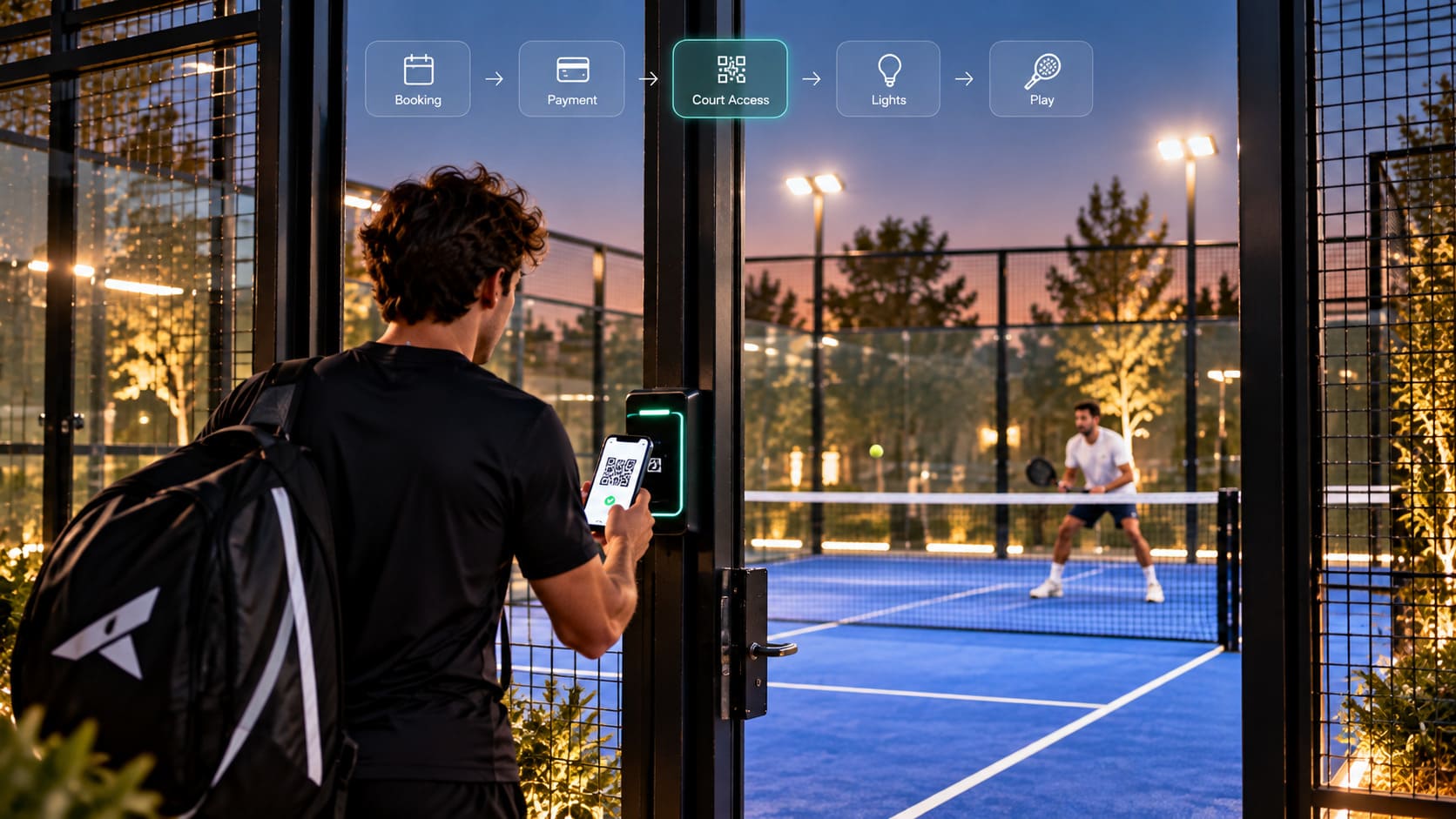
Nothing stops you from renting your courts 24/7 thanks to access control and automated lighting. This is especially relevant in summer, when extreme heat pushes players to play much later in the evening, even at night.
The 6 a.m. to 8 a.m. and 10 p.m. to midnight slots are often underused not because of lack of demand, but because of staffing constraints. In urban areas, there is a real audience of players who want to play early before work or late after dinner.
Managers report up to +35% revenue in 3 months thanks to opening night slots with a self-service court system. Those extra hours are almost pure revenue: the court is already amortized, fixed costs stay the same.
Lever 6: Regular tournaments and events
A monthly tournament has two positive effects on your occupancy rate: it fills entire slots on a full day or weekend, and it builds community around your club — which increases how often your members visit.
Tournaments generate significant economic spin-offs for organizing clubs — court rentals, bar sales, pro shop — with average revenue of €15,000 to €50,000 per event depending on scale.
Do not limit yourself to classic tournaments. Americanos, corporate challenges, beginner discovery nights, inter-club challenges: each format creates an opportunity to fill your courts during slots that would otherwise stay empty.
Lever 7: Targeted communication with your member base
Your member database is your most valuable asset. A player who has not played in 3 weeks is a player who may not come back. A personalized message at the right time can change that.
Segment your communication: send reminders to players inactive for more than 10 days, offer referral incentives to your most active members, communicate upcoming tournaments to players who have already taken part in one, create targeted campaigns for off-peak slots among players available during the day.
This targeted communication is infinitely more effective than a generic Instagram post. It requires a tool capable of segmenting your database and sending personalized messages by SMS, email or push notification — from a single interface.
Lever 8: Real-time management of key metrics
You cannot improve what you do not measure. The clubs that are improving the fastest in occupancy are the ones that review their numbers every week — not every month.
Key indicators to monitor: occupancy rate by court and by time slot, cancellation rate and average cancellation lead time, revenue by source (court hire, subscriptions, lessons, tournaments, bar), weekly growth in new members, retention rate at 30, 60 and 90 days.
With this data, you can pinpoint exactly where your club is losing revenue — and which levers to activate first.
Doinsport: the solution that activates all these levers from a single platform
The good news: all the levers described in this article do not require eight different tools. They require one well-designed tool.
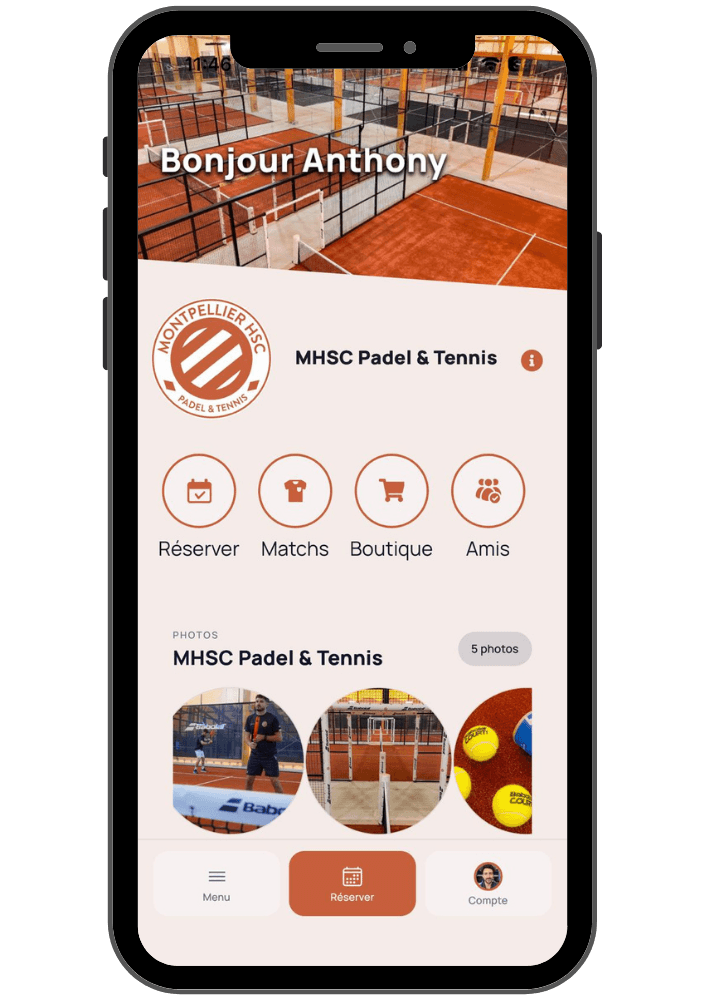
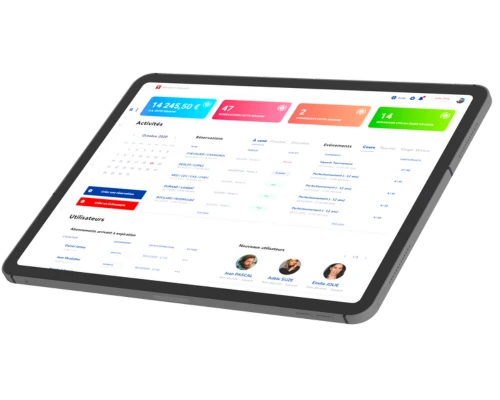
That is exactly what the Doinsport management app for padel clubs offers: a complete platform that centralizes 24/7 online booking, targeted push notifications, subscription and recurring slot management, tournament organization, segmented member communication, and a real-time analytics dashboard — plus a white-label mobile app in your branding so your members can book directly from your app.
And if you want to open night slots without staff, the self-service padel court solution Doinsport enables 24/7 access with access control and automated lighting — with no upfront investment.
👉 Request a free demo — an expert will call you back within 30 minutes to assess your club's situation and identify the priority levers.
FAQ — Padel club occupancy rate
What is the average occupancy rate of a padel club in France? The average occupancy rate exceeds 50% in private clubs, with very significant gaps, sometimes ranging from one to three times, between high-performing urban centers and less optimized facilities.
At what occupancy rate does a padel club become profitable? The break-even point depends on your fixed costs, but most business models reach balance between 45% and 55% occupancy. Beyond that, every additional point translates directly into net profit.
How can you reduce no-shows in a padel club? Upfront payment at booking is the most effective method. Combined with automatic SMS reminders or push notifications the day before the slot, it drastically reduces no-shows.
Do subscriptions hurt schedule flexibility? On the contrary. Recurring slot subscriptions are the foundation of a stable schedule. They let you build a predictable revenue base on top of which you add pay-as-you-play bookings to maximize occupancy.
Do you need to lower prices to fill off-peak slots? Not necessarily. A slight price reduction during off-peak hours (10 to 15%) is usually enough to stimulate demand without devaluing your offer. The goal is to monetize slots that would otherwise remain empty; partial revenue is always better than zero.
Operational guide · 8 concrete levers · Data-driven figures
Occupancy rate, the metric that changes everything
You can have the best courts in town, a friendly team, and a welcoming clubhouse. If your slots are not filled, your club will never be profitable.
Between average revenue of €80,000 per court and occupancy above 50%, padel confirms it has become a genuine economic driver for private clubs. But behind that national average lie significant gaps: some clubs post 75% occupancy, while others struggle to get above 35%. The difference has nothing to do with luck or location alone => it comes down to how the club is managed and operated day to day.
Player satisfaction with slot availability stands at just 57% in France, the lowest-rated criterion of all. In other words: demand is there, structurally unmet. The manager's job is to capture that demand with the right tools and the right strategies.
Here are the 8 most effective levers to increase your occupancy rate in 2026.
How to calculate your occupancy rate
Before optimizing, you need to measure. The calculation is simple:
Occupancy rate = (reserved hours ÷ available hours) × 100
Example: a club with 4 courts open 14 hours a day, 7 days a week, has 392 available hours per week. If it rents 220 of them, its occupancy rate is 56%.
The classic trap is to calculate an overall rate that masks major differences by time slot. A club can show 60% overall occupancy while its evening slots are at 95% and its weekday mornings at 20%. Those empty slots are the ones you need to address first.
Lever 1: 24/7 online booking
This is the first lever, and by far the most impactful. A player who wants to book a court at 10:30 p.m. for the next morning is not going to call your front desk. If they cannot book from their phone in less than 60 seconds, they will go elsewhere — or they will not play at all.
Today, everything happens on smartphones: booking a court, finding playing partners, signing up for a tournament. Yet many facilities still operate with poorly suited tools — phone reservations, Excel schedules, communication via WhatsApp groups. The result: booking errors, wasted time, and missed slots.
24/7 online booking with upfront payment has two direct effects on your occupancy rate: it removes friction at the moment of decision, and it drastically reduces no-shows because the player has already paid.
Lever 2: Push notifications to fill newly freed slots
A player cancels at 6 p.m. for an 8 p.m. slot. Without a notification system, that court stays empty. With an app connected to your member database, you can send a push notification to all your players in a few seconds: the slot is rebooked in less than ten minutes.
This single lever can represent several occupancy points over the year — meaning several thousand euros in recovered revenue on slots that would otherwise have been lost.
Advanced tip: segment your notifications. Prioritize the alert to players who have already booked that slot before, or to those with a history of weekday evening bookings. The more targeted the message, the higher the conversion rate.
Lever 3: Dynamic pricing for off-peak slots
You can offer reduced weekday daytime rates to optimize your booking schedule. That is dynamic pricing applied to padel: varying your price based on demand to maximize occupancy for every slot.
In practical terms: your evening and weekend slots sell themselves. The challenge is filling weekday mornings and weekday afternoons outside school holidays.
A few approaches that work: discounted last-minute pricing for off-peak slots (2 days out), 'happy hour' pricing from 10 a.m. to 12 p.m. Monday to Friday, corporate offers on fixed daytime slots, off-peak slot subscriptions with a monthly commitment.
Lever 4: Subscriptions to secure recurring slots
A player who books the same slot every week for 3 years never disappears from your schedule. A player without a subscription can cancel overnight. The difference between a club at 55% occupancy and one at 70% is often the share of slots locked in by subscriptions.
Monthly or annual subscriptions are the best way to build loyalty while securing your occupancy rate.
Offer recurring slot subscriptions at a slightly preferential rate (5 to 10% discount) in exchange for a monthly commitment. You gain revenue predictability, your player gains convenience. Everybody wins.
Lever 5: Opening night and early-morning slots
Nothing stops you from renting your courts 24/7 thanks to access control and automated lighting. This is especially relevant in summer, when extreme heat pushes players to play much later in the evening, even at night.
The 6 a.m. to 8 a.m. and 10 p.m. to midnight slots are often underused not because of lack of demand, but because of staffing constraints. In urban areas, there is a real audience of players who want to play early before work or late after dinner.
Managers report up to +35% revenue in 3 months thanks to opening night slots with a self-service court system. Those extra hours are almost pure revenue: the court is already amortized, fixed costs stay the same.
Lever 6: Regular tournaments and events
A monthly tournament has two positive effects on your occupancy rate: it fills entire slots on a full day or weekend, and it builds community around your club — which increases how often your members visit.
Tournaments generate significant economic spin-offs for organizing clubs — court rentals, bar sales, pro shop — with average revenue of €15,000 to €50,000 per event depending on scale.
Do not limit yourself to classic tournaments. Americanos, corporate challenges, beginner discovery nights, inter-club challenges: each format creates an opportunity to fill your courts during slots that would otherwise stay empty.
Lever 7: Targeted communication with your member base
Your member database is your most valuable asset. A player who has not played in 3 weeks is a player who may not come back. A personalized message at the right time can change that.
Segment your communication: send reminders to players inactive for more than 10 days, offer referral incentives to your most active members, communicate upcoming tournaments to players who have already taken part in one, create targeted campaigns for off-peak slots among players available during the day.
This targeted communication is infinitely more effective than a generic Instagram post. It requires a tool capable of segmenting your database and sending personalized messages by SMS, email or push notification — from a single interface.
Lever 8: Real-time management of key metrics
You cannot improve what you do not measure. The clubs that are improving the fastest in occupancy are the ones that review their numbers every week — not every month.
Key indicators to monitor: occupancy rate by court and by time slot, cancellation rate and average cancellation lead time, revenue by source (court hire, subscriptions, lessons, tournaments, bar), weekly growth in new members, retention rate at 30, 60 and 90 days.
With this data, you can pinpoint exactly where your club is losing revenue — and which levers to activate first.
Doinsport: the solution that activates all these levers from a single platform
The good news: all the levers described in this article do not require eight different tools. They require one well-designed tool.
That is exactly what the Doinsport management app for padel clubs offers: a complete platform that centralizes 24/7 online booking, targeted push notifications, subscription and recurring slot management, tournament organization, segmented member communication, and a real-time analytics dashboard — plus a white-label mobile app in your branding so your members can book directly from your app.
And if you want to open night slots without staff, the self-service padel court solution Doinsport enables 24/7 access with access control and automated lighting — with no upfront investment.
👉 Request a free demo — an expert will call you back within 30 minutes to assess your club's situation and identify the priority levers.
FAQ — Padel club occupancy rate
What is the average occupancy rate of a padel club in France? The average occupancy rate exceeds 50% in private clubs, with very significant gaps, sometimes ranging from one to three times, between high-performing urban centers and less optimized facilities.
At what occupancy rate does a padel club become profitable? The break-even point depends on your fixed costs, but most business models reach balance between 45% and 55% occupancy. Beyond that, every additional point translates directly into net profit.
How can you reduce no-shows in a padel club? Upfront payment at booking is the most effective method. Combined with automatic SMS reminders or push notifications the day before the slot, it drastically reduces no-shows.
Do subscriptions hurt schedule flexibility? On the contrary. Recurring slot subscriptions are the foundation of a stable schedule. They let you build a predictable revenue base on top of which you add pay-as-you-play bookings to maximize occupancy.
Do you need to lower prices to fill off-peak slots? Not necessarily. A slight price reduction during off-peak hours (10 to 15%) is usually enough to stimulate demand without devaluing your offer. The goal is to monetize slots that would otherwise remain empty; partial revenue is always better than zero.
Similar articles
Oct 14, 2026
How Does Access Control Work for Padel Clubs? QR Codes, RFID, Smart Locks, Court Lighting, and Bookings Explained.

Oct 1, 2026
How to Drive Player Retention at Your Padel Club: Discover 10 Proven Strategies to Boost Court Bookings, Re-engage Members, and Grow Your Revenue.

Take your club to the next level
Ready to transform your padel, tennis, and country club?
Join the +1,000 clubs that trust Doinsport. Get started in less than 30 minutes and see the difference from the very first day.
We are here to support you.


Take your club to the next level
Ready to transform your padel, tennis, and country club?
Join the +1,000 clubs that trust Doinsport. Get started in less than 30 minutes and see the difference from the very first day.
Take your club to the next level
Ready to transform your padel, tennis, and country club?
Join the +1,000 clubs that trust Doinsport. Get started in less than 30 minutes and see the difference from the very first day.
We are here to support you.