

EN
EN
Padel
How Does Smart Access Control Work for a Padel Club?
How Does Access Control Work for Padel Clubs? QR Codes, RFID, Smart Locks, Court Lighting, and Bookings Explained.
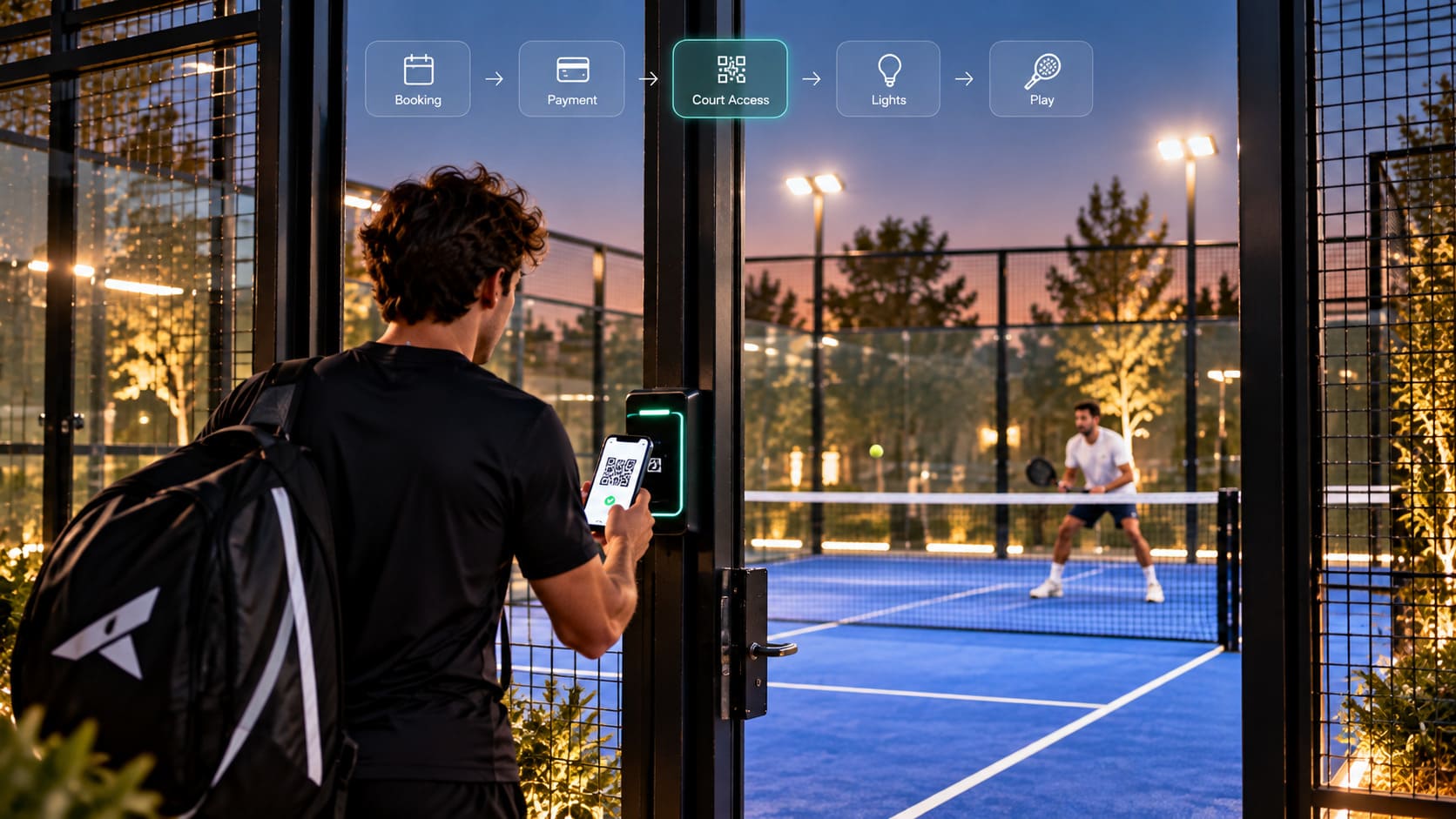
Book a court at 10 PM, pay directly from a smartphone, automatically receive access credentials, and walk straight into the club without stopping at the front desk. This frictionless experience is now possible thanks to connected access control for padel clubs.
Yet behind a seamless QR code or RFID badge scan lies an integrated technical workflow. To operate smoothly, the system must verify:
who booked the court, and whether the booking is confirmed
the exact arrival window, and when access rights expire
which facility zones the player is permitted to enter
whether court lighting should trigger, and what happens once the slot ends
Access control shouldn't be treated as a standalone smart lock, but as a core link connected to your booking engine, payment processing, and club operating rules.
Here is how this architecture works, which technologies to choose, and the key checkpoints before equipping your facility.
Key Takeaways
Access = Identity + Permission + Validity Window.
Access rights are automatically generated, rescheduled, or revoked alongside the booking.
QR codes for pay-and-play guests; RFID cards or fobs for regular members.
Automated lighting syncs with court schedules to eliminate unnecessary energy costs.
Always map out your facility zones and player flows before investing in hardware.
What Is Connected Access Control for Padel Clubs?
Connected access control automatically grants or restricts entry to specific club zones. The concept relies on a simple formula:
Identity + Permission + Validity Window = Authorized Access
In a padel club, this permission can depend on:
a confirmed court booking or active membership
the user role (casual player, member, coach, staff, etc.)
a specific time window and designated zone
payment confirmation status
The system does far more than recognize a player: it determines exactly what that individual is permitted to access at that specific moment.
For instance, a premium member might enjoy clubhouse access throughout designated opening hours, whereas a casual guest only gains entry around their booked court slot. This intelligent logic is precisely what separates connected access control from a basic electronic lock.
Further reading: smart access control solutions for padel and tennis clubs
How Does the End-to-End Player Journey Work?
The ideal setup relies on an automated workflow connecting the club’s schedule directly to physical facility access. Here is the 7-step journey.
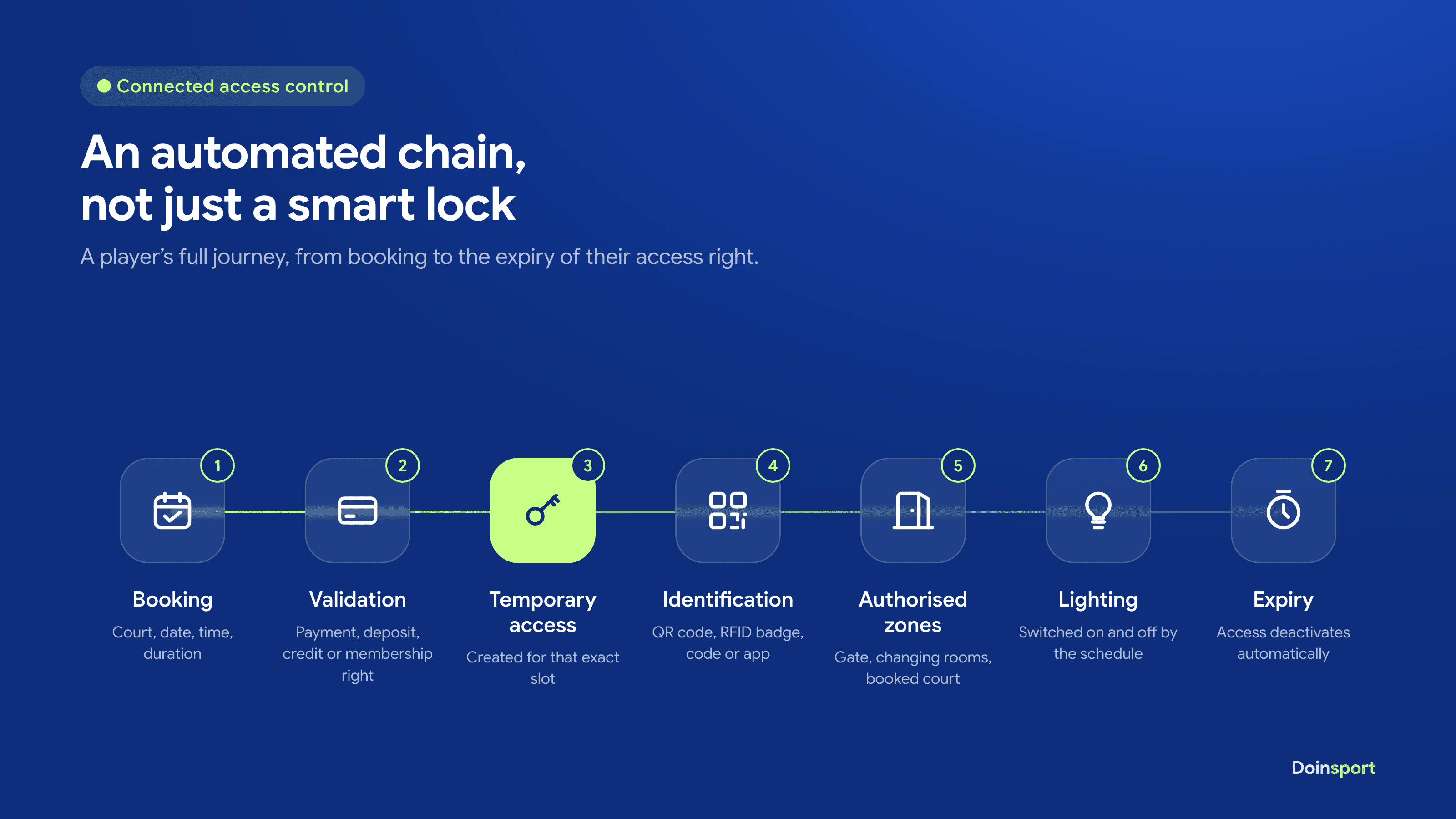
1. The Player Books a Court
The player checks real-time availability and selects their court, date, start time, and duration. The platform creates a reservation linked to their account. At this stage, no permanent credentials are required.
2. The Booking Is Validated
Depending on your club’s policies, booking confirmation may require:
full payment or an upfront deposit
a pre-authorized card hold
wallet credits
or simply member entitlement validation
Once these criteria are met, the booking is confirmed. Syncing access control with online payment processing for sports clubs prevents automatic entry for bookings that fail to meet facility rules.
3. A Temporary Access Pass Is Generated
The system now knows the player + the court + the date + the time slot. It can generate access credentials tailored precisely to that booking.
Example: Court 3 booked from 7:00 PM to 8:30 PM → Access window active from 6:50 PM to 8:40 PM.
The player can enter a few minutes before their match and leave comfortably after, without ever holding permanent credentials.
4. The Player Authenticates at the Gate
Depending on your club’s hardware, they scan a QR code, enter a temporary PIN, scan an RFID badge, tap a wristband, or use their mobile app. The reader validates the credentials against active permissions: if verified, the door unlocks; if not, it stays secure.
5. The Player Accesses Authorized Zones Only
Access points across a facility rarely share the same rules. A venue might feature an exterior gate, clubhouse, locker rooms, multiple courts, a gym area, and back-of-house staff rooms.
A player can unlock the perimeter gate, locker rooms, and their reserved court, without gaining entry to unauthorized areas.
6. Court Lighting Triggers Automatically
For outdoor courts or autonomous facilities, the booking doubles as an automation trigger. Knowing the exact start and end times, the system switches court lights on right on schedule and powers them down once play finishes.
7. Access Automatically Expires
Once the time slot ends, the authorization has no reason to remain active: the system revokes it automatically.
Booking → Validation → Access → Court Use → Expiration: this complete loop enables genuine facility automation.
QR Code, RFID, or PIN Code: Which Technology Should You Choose?
No single technology fits every player profile. The right choice primarily depends on visit frequency and club operations.

QR Codes: Best for Pay-and-Play Guests
Players receive a dynamic QR code directly on their smartphone to present at the scanner. This is ideal for first-time or casual visitors, completely removing the need to hand out physical cards or key fobs.
Zero physical inventory to manage
Time-restricted temporary access by default
100% digital guest experience
RFID Cards & Fobs: Preferred for Regular Members
Members tap their keycard, fob, or wristband against the reader. The system reads the unique identifier and checks their current permissions in milliseconds.
Ultra-fast and frictionless
No need to pull out a phone
Durable, long-term credential
Good to know: the card itself does not store access rights. The club management software decides in real time whether entry is permitted when the card is scanned.
Temporary PIN Codes: Practical, but Requires Clear Controls
The platform generates a numeric PIN that the player enters on a keypad at the door. No physical credential, no smartphone needed: highly convenient for occasional visitors.
Important note: Keypad codes can easily be shared. Always opt for dynamic, booking-specific codes rather than static master codes shared across multiple players.
Which Technology for Which Profile?
User Profile | Recommended Technology |
|---|---|
Pay-and-play / Casual player | QR Code or temporary PIN |
Active member | RFID card/fob or mobile app |
Coach | RFID or role-based smart access |
Club manager / Admin | Master access permissions |
External contractor | Time-limited specific pass |
Ultimately, the primary asset is neither the QR code nor the RFID badge: the real power lies in the access rules defined for each user profile.
How to Manage Multiple Facility Zones in a Padel Club
Access control should never operate as a blunt "door locked / door unlocked" mechanism. Consider a club with a main gate, six courts, two changing rooms, a clubhouse, a fitness room, and a staff storage area: each user needs customized access.

Casual player: main gate, locker rooms, and their booked court. Back-of-house areas remain locked.
Premium subscriber: main gate, locker rooms, booked court, plus fitness area included in their plan.
Staff member: main gate, locker rooms, all courts, and operational rooms based on their role.
Configured this way, access control becomes a genuine operational asset for governing multi-zone sports facilities.
Connecting Access Control Directly to Your Court Booking System
This is arguably the most critical technical integration. The access system must instantly register when a booking is created, rescheduled, extended, or canceled, requiring continuous two-way communication with your club schedule.
With an integrated padel club management software, access rights sync natively with the court schedule:
Court booked → corresponding access rights are instantly provisioned.
Booking rescheduled → access windows shift automatically.
Booking canceled → access credentials are automatically revoked.
Without this real-time sync, staff must manually update permissions after every change, defeating the core purpose of an automated system.
How to Automate Court Lighting in a Padel Facility
Without smart automation, clubs frequently suffer avoidable overhead costs:
Courts illuminated long before players arrive
Floodlights left running overnight after a match
Manual staff rounds required to switch lights on and off
Empty courts burning electricity during no-shows
Integrated with the booking schedule, smart relay modules turn lighting on and off precisely when needed. Here is a typical automation rule:
6:55 PM: Court lighting turns on
7:00 PM: Match begins
8:30 PM: Match ends
8:35 PM: Lights shut down unless a subsequent booking is scheduled
Buffer times can be customized to your club’s operations. The benefits are clear: an elevated player experience combined with drastic reductions in utility bills.

What Happens When Bookings Are Back-to-Back?
If Player A books from 6:00 PM to 7:30 PM and Player B books from 7:30 PM to 9:00 PM, cutting the lights off only to restart them is counterproductive. Intelligent systems recognize consecutive slots and keep lighting active throughout.
Smart facility automation never evaluates bookings in isolation: it evaluates the complete court calendar.
Can You Run an Unmanned, Autonomous Padel Club?
Yes, provided you automate several operational layers simultaneously:
Self-service booking: players select their court and slot online without staff assistance.
Digital payments: payments and deposits clear automatically.
Smart entry: digital credentials dispatch automatically to the player's device.
Zone access: the facility unlocks only the relevant areas for that booking.
Automated lighting: court utilities trigger according to live bookings.
Remote support: clear emergency contact and escalation protocols are in place.
The objective isn't simply slapping a smart lock on a gate; it's about delivering an end-to-end autonomous customer journey.
Further reading: how autonomous padel clubs operate
What Hardware Do You Need to Automate Facility Access?
Hardware requirements depend on your venue layout and desired level of automation. A typical project includes:
Identification: QR code scanners, RFID readers, digital keypads
Locking mechanisms: electric strikes, electromagnetic locks, motorized gates
Control units: access controllers, smart relays for lighting management
Infrastructure: PoE network wiring, power supplies, battery backups (UPS)
A successful project never starts with "Which lock should we buy?" but with "What player journey and which facility zones do we want to automate?". Hardware specifications flow naturally from that architecture.
Ethernet, Wi-Fi, or 4G/5G: Which Connectivity Should You Choose?
Some venues benefit from hardwired Ethernet infrastructure or robust Wi-Fi, while others operate outdoor courts far from the main clubhouse. In the latter scenario, relying solely on Wi-Fi creates operational vulnerability. Depending on the setup, remote gates can leverage cellular (4G/5G) controllers and self-powered systems.
Before deployment, always audit:
wireless coverage quality across all gates
available power supply at each access point
cable distances between hardware components
network redundancy and failover capabilities
offline emergency opening procedures
What Happens During a Power or Internet Outage?
Reliability in adverse conditions must be addressed during the planning phase. Depending on setup, best-practice deployments feature: battery backups (UPS), autonomous offline cache, manual keyed overrides, remote admin triggers, and on-call support workflows.
Requirements differ for an exterior perimeter gate, a clubhouse door, or an emergency exit. One rule remains non-negotiable: access automation must never compromise building fire and life safety regulations.
Early Arrivals, Latecomers, and Cancellations: How the System Responds
Configurable time buffers handle daily real-world scenarios smoothly without requiring front-desk intervention.

What Happens if a Player Arrives Early?
For a 7:00 PM – 8:30 PM booking, the club can activate credentials starting at 6:50 PM. A player scanning in at 6:30 PM will be denied entry; at 6:52 PM, the gate unlocks. Managers set the custom grace period that fits their facility flow, preventing unauthorized loitering hours ahead of play.
What if a Player Arrives Late?
As long as the booking window is still active, credentials remain valid: a player arriving at 7:15 PM for a 7:00 PM – 8:30 PM slot enters without issue. Smart access control shouldn't introduce friction—it simply enforces club policies automatically.
What Happens if a Booking Is Canceled?
The logic is straightforward: booking canceled = access instantly revoked. The QR code or temporary pass assigned to that session stops working immediately, eliminating orphaned credentials across your facility.
Can You Partially Automate Your Club?
Absolutely. You don’t need to switch to 100% autonomous operations overnight. Many venues run a hybrid model: full front-desk staffing from 9:00 AM to 8:00 PM, transitioning to autonomous self-service from 7:00 AM to 9:00 AM and 8:00 PM to 11:00 PM.
Smart access allows you to expand operating hours and boost revenue without bloating payroll. You can also phase your rollout by automating exterior gates and court access first, leaving other areas for later.
Operational Benefits for Club Owners and Staff
Connected access control removes repetitive, manual chores: opening gates, verifying reservations, handing out physical keys, turning light switches, and conducting late-night lock-ups.
Your team can focus on high-impact hospitality and growth initiatives: player welcoming, pro shop sales, coaching clinics, corporate tournaments, and community building.
The goal isn't to eliminate personal touch, but to free your staff to deliver high-value experiences where human connection truly counts.
The Risks of a Poorly Implemented Access Setup
A poorly architected system creates more headaches than it solves. Here are the 6 most common pitfalls:
Siloed software: if booking and access control run independently, staff must manually double-enter data every day.
Static keypad codes: master codes shared with multiple players inevitably leak and compromise security.
Overly broad permissions: unlocking the entire venue when a player only needs Court 2 increases liability.
Fragile connectivity: your club cannot afford lockouts whenever the internet flickers.
No failover procedures: even fully autonomous setups require clear manual override procedures.
Incomplete zone mapping: securing a court door while perimeter gates remain wide open compromises your entire investment.
Access Control & Facility Security: Questions to Ask Before Installation
Before procuring hardware, map out your entire facility. For every entry point, review these 8 essential questions:
Who requires access to this zone?
During which hours or schedules?
What identification credential fits best (QR, RFID, mobile app)?
Which secondary zones should this credential unlock?
What happens the minute permissions expire?
How does the entry point behave during power or network outages?
Is an emergency mechanical egress or fail-safe lock mandatory?
Does this zone require automated lighting integration?
Answering these early ensures a secure, scalable, and coherent facility design.
Sample Architecture for a 6-Court Padel Club
Consider a sports club featuring an exterior vehicle gate, six padel courts, two changing rooms, a clubhouse, and a maintenance room.
Player Journey
Player books Court 4 for 8:00 PM and completes online checkout.
The platform generates an automated temporary access pass.
They arrive 10 minutes prior and scan through the main gate.
They access the changing rooms and enter Court 4.
Court lighting triggers according to the booked schedule.
Once their slot concludes, the access pass expires automatically.
Staff Journey
Staff members hold an RFID fob or mobile credential with broader facility permissions, matched to their work schedules.
Contractor Journey
A maintenance technician visiting Tuesday morning receives access strictly limited to Tuesday from 9:00 AM to 12:00 PM, unlocking only the perimeter gate and maintenance room.
This granular approach provides vastly superior security compared to a static gate code shared among hundreds of people.
Standalone Hardware vs. All-in-One Club Management Software
You could assemble separate vendors for online bookings, payment gateways, access controllers, and lighting automation. However, stitching disparate tools together creates critical integration vulnerabilities:
The booking engine must reflect verified payments instantly
Access control must listen to live booking adjustments
Lighting relays must trigger from the master court schedule
Reporting and analytics must aggregate all operational data into a single dashboard
Choosing an all-in-one padel club management platform bridges these silos, eliminates integration overhead, and drastically cuts down manual tasks.
12 Questions to Ask Before Choosing an Access Control Provider
Before selecting a vendor, run through these questions. They evaluate vendors on practical, real-world club performance rather than just raw hardware pricing.
Does the system integrate natively with my court booking software?
What happens to access rights when a reservation is canceled or rescheduled?
Can the system generate time-restricted temporary passes?
Does it support dynamic QR codes?
Can it issue and manage physical RFID cards or fobs?
Can I configure multi-zone permissions across different facility areas?
Can I set distinct permission tiers for members, guests, coaches, and staff?
Can it automate court floodlights directly from the booking schedule?
How does the system operate during an internet or power outage?
What manual and emergency override options are included?
Can club managers trigger remote unlocks via mobile or web dashboard?
Can the infrastructure scale smoothly if I expand court capacity later?
FAQ — Access Control for Padel Clubs
How does smart access control work for a padel court?
The system verifies that a player holds valid access credentials linked to an active booking, membership tier, or staff role. The player authenticates via QR code, RFID badge, PIN, or mobile app, and the lock releases only if all operational criteria are met.
Can QR codes be generated automatically upon booking?
Yes. An integrated platform automatically generates a temporary, dynamic QR code valid strictly for the scheduled match window.
What is the difference between QR Codes and RFID for sports clubs?
QR codes are ideal for pay-and-play and casual players because they require zero physical media. RFID cards and fobs are perfect for daily members, coaches, and staff who value instant, tap-and-go convenience.
Can you automate padel court lighting with access control?
Yes. When your court schedule and smart electrical relays are connected, lighting switches on and off automatically based on live bookings.
Can you manage multiple access zones within one facility?
Yes. Entry gates, clubhouses, locker rooms, individual courts, and staff quarters can each run on dedicated permission rules tailored to user profiles.
Can you operate a padel club completely unstaffed?
The vast majority of the customer journey can be fully automated: booking, payment, gate access, and lighting. However, clubs must still establish structured protocols for facility maintenance, emergency support, and incident management.
What happens to access rights when a player cancels a court?
In an integrated system, canceling a booking immediately invalidates the associated QR code or access credential.
Does smart access control work without Wi-Fi?
Yes. Systems can utilize hardwired Ethernet (PoE), dedicated cellular (4G/5G) connections, and local offline cache memory to ensure continuous operation.
How much does an access control system cost for a padel club?
Total investment depends on the number of access points, chosen reader technologies, electric lock types, electrical infrastructure, network requirements, and lighting automation features. A facility site survey is the most reliable way to obtain an accurate quote.
Can access control be retrofitted into an existing padel facility?
Yes. Most systems can be retrofitted onto existing gates, manual doors, and electrical panels, subject to site feasibility.
Summary: Access Control Is a Connected Ecosystem, Not Just a Lock
Automating access for a padel club is never as simple as mounting a standalone QR reader onto a gate. A high-performing system relies on a unified, automated chain:
Court booking
Payment validation
Automated credential provisioning
Player authentication
Zoned facility access
Court lighting automation
Automatic credential expiration
The more seamlessly these components communicate, the fewer manual interventions your team handles: access control transforms into a core pillar of your club management strategy.
Ready to explore smart automation for your sports facility? Book a demo with Doinsport →
Book a court at 10 PM, pay directly from a smartphone, automatically receive access credentials, and walk straight into the club without stopping at the front desk. This frictionless experience is now possible thanks to connected access control for padel clubs.
Yet behind a seamless QR code or RFID badge scan lies an integrated technical workflow. To operate smoothly, the system must verify:
who booked the court, and whether the booking is confirmed
the exact arrival window, and when access rights expire
which facility zones the player is permitted to enter
whether court lighting should trigger, and what happens once the slot ends
Access control shouldn't be treated as a standalone smart lock, but as a core link connected to your booking engine, payment processing, and club operating rules.
Here is how this architecture works, which technologies to choose, and the key checkpoints before equipping your facility.
Key Takeaways
Access = Identity + Permission + Validity Window.
Access rights are automatically generated, rescheduled, or revoked alongside the booking.
QR codes for pay-and-play guests; RFID cards or fobs for regular members.
Automated lighting syncs with court schedules to eliminate unnecessary energy costs.
Always map out your facility zones and player flows before investing in hardware.
What Is Connected Access Control for Padel Clubs?
Connected access control automatically grants or restricts entry to specific club zones. The concept relies on a simple formula:
Identity + Permission + Validity Window = Authorized Access
In a padel club, this permission can depend on:
a confirmed court booking or active membership
the user role (casual player, member, coach, staff, etc.)
a specific time window and designated zone
payment confirmation status
The system does far more than recognize a player: it determines exactly what that individual is permitted to access at that specific moment.
For instance, a premium member might enjoy clubhouse access throughout designated opening hours, whereas a casual guest only gains entry around their booked court slot. This intelligent logic is precisely what separates connected access control from a basic electronic lock.
Further reading: smart access control solutions for padel and tennis clubs
How Does the End-to-End Player Journey Work?
The ideal setup relies on an automated workflow connecting the club’s schedule directly to physical facility access. Here is the 7-step journey.
1. The Player Books a Court
The player checks real-time availability and selects their court, date, start time, and duration. The platform creates a reservation linked to their account. At this stage, no permanent credentials are required.
2. The Booking Is Validated
Depending on your club’s policies, booking confirmation may require:
full payment or an upfront deposit
a pre-authorized card hold
wallet credits
or simply member entitlement validation
Once these criteria are met, the booking is confirmed. Syncing access control with online payment processing for sports clubs prevents automatic entry for bookings that fail to meet facility rules.
3. A Temporary Access Pass Is Generated
The system now knows the player + the court + the date + the time slot. It can generate access credentials tailored precisely to that booking.
Example: Court 3 booked from 7:00 PM to 8:30 PM → Access window active from 6:50 PM to 8:40 PM.
The player can enter a few minutes before their match and leave comfortably after, without ever holding permanent credentials.
4. The Player Authenticates at the Gate
Depending on your club’s hardware, they scan a QR code, enter a temporary PIN, scan an RFID badge, tap a wristband, or use their mobile app. The reader validates the credentials against active permissions: if verified, the door unlocks; if not, it stays secure.
5. The Player Accesses Authorized Zones Only
Access points across a facility rarely share the same rules. A venue might feature an exterior gate, clubhouse, locker rooms, multiple courts, a gym area, and back-of-house staff rooms.
A player can unlock the perimeter gate, locker rooms, and their reserved court, without gaining entry to unauthorized areas.
6. Court Lighting Triggers Automatically
For outdoor courts or autonomous facilities, the booking doubles as an automation trigger. Knowing the exact start and end times, the system switches court lights on right on schedule and powers them down once play finishes.
7. Access Automatically Expires
Once the time slot ends, the authorization has no reason to remain active: the system revokes it automatically.
Booking → Validation → Access → Court Use → Expiration: this complete loop enables genuine facility automation.
QR Code, RFID, or PIN Code: Which Technology Should You Choose?
No single technology fits every player profile. The right choice primarily depends on visit frequency and club operations.
QR Codes: Best for Pay-and-Play Guests
Players receive a dynamic QR code directly on their smartphone to present at the scanner. This is ideal for first-time or casual visitors, completely removing the need to hand out physical cards or key fobs.
Zero physical inventory to manage
Time-restricted temporary access by default
100% digital guest experience
RFID Cards & Fobs: Preferred for Regular Members
Members tap their keycard, fob, or wristband against the reader. The system reads the unique identifier and checks their current permissions in milliseconds.
Ultra-fast and frictionless
No need to pull out a phone
Durable, long-term credential
Good to know: the card itself does not store access rights. The club management software decides in real time whether entry is permitted when the card is scanned.
Temporary PIN Codes: Practical, but Requires Clear Controls
The platform generates a numeric PIN that the player enters on a keypad at the door. No physical credential, no smartphone needed: highly convenient for occasional visitors.
Important note: Keypad codes can easily be shared. Always opt for dynamic, booking-specific codes rather than static master codes shared across multiple players.
Which Technology for Which Profile?
User Profile | Recommended Technology |
|---|---|
Pay-and-play / Casual player | QR Code or temporary PIN |
Active member | RFID card/fob or mobile app |
Coach | RFID or role-based smart access |
Club manager / Admin | Master access permissions |
External contractor | Time-limited specific pass |
Ultimately, the primary asset is neither the QR code nor the RFID badge: the real power lies in the access rules defined for each user profile.
How to Manage Multiple Facility Zones in a Padel Club
Access control should never operate as a blunt "door locked / door unlocked" mechanism. Consider a club with a main gate, six courts, two changing rooms, a clubhouse, a fitness room, and a staff storage area: each user needs customized access.
Casual player: main gate, locker rooms, and their booked court. Back-of-house areas remain locked.
Premium subscriber: main gate, locker rooms, booked court, plus fitness area included in their plan.
Staff member: main gate, locker rooms, all courts, and operational rooms based on their role.
Configured this way, access control becomes a genuine operational asset for governing multi-zone sports facilities.
Connecting Access Control Directly to Your Court Booking System
This is arguably the most critical technical integration. The access system must instantly register when a booking is created, rescheduled, extended, or canceled, requiring continuous two-way communication with your club schedule.
With an integrated padel club management software, access rights sync natively with the court schedule:
Court booked → corresponding access rights are instantly provisioned.
Booking rescheduled → access windows shift automatically.
Booking canceled → access credentials are automatically revoked.
Without this real-time sync, staff must manually update permissions after every change, defeating the core purpose of an automated system.
How to Automate Court Lighting in a Padel Facility
Without smart automation, clubs frequently suffer avoidable overhead costs:
Courts illuminated long before players arrive
Floodlights left running overnight after a match
Manual staff rounds required to switch lights on and off
Empty courts burning electricity during no-shows
Integrated with the booking schedule, smart relay modules turn lighting on and off precisely when needed. Here is a typical automation rule:
6:55 PM: Court lighting turns on
7:00 PM: Match begins
8:30 PM: Match ends
8:35 PM: Lights shut down unless a subsequent booking is scheduled
Buffer times can be customized to your club’s operations. The benefits are clear: an elevated player experience combined with drastic reductions in utility bills.
What Happens When Bookings Are Back-to-Back?
If Player A books from 6:00 PM to 7:30 PM and Player B books from 7:30 PM to 9:00 PM, cutting the lights off only to restart them is counterproductive. Intelligent systems recognize consecutive slots and keep lighting active throughout.
Smart facility automation never evaluates bookings in isolation: it evaluates the complete court calendar.
Can You Run an Unmanned, Autonomous Padel Club?
Yes, provided you automate several operational layers simultaneously:
Self-service booking: players select their court and slot online without staff assistance.
Digital payments: payments and deposits clear automatically.
Smart entry: digital credentials dispatch automatically to the player's device.
Zone access: the facility unlocks only the relevant areas for that booking.
Automated lighting: court utilities trigger according to live bookings.
Remote support: clear emergency contact and escalation protocols are in place.
The objective isn't simply slapping a smart lock on a gate; it's about delivering an end-to-end autonomous customer journey.
Further reading: how autonomous padel clubs operate
What Hardware Do You Need to Automate Facility Access?
Hardware requirements depend on your venue layout and desired level of automation. A typical project includes:
Identification: QR code scanners, RFID readers, digital keypads
Locking mechanisms: electric strikes, electromagnetic locks, motorized gates
Control units: access controllers, smart relays for lighting management
Infrastructure: PoE network wiring, power supplies, battery backups (UPS)
A successful project never starts with "Which lock should we buy?" but with "What player journey and which facility zones do we want to automate?". Hardware specifications flow naturally from that architecture.
Ethernet, Wi-Fi, or 4G/5G: Which Connectivity Should You Choose?
Some venues benefit from hardwired Ethernet infrastructure or robust Wi-Fi, while others operate outdoor courts far from the main clubhouse. In the latter scenario, relying solely on Wi-Fi creates operational vulnerability. Depending on the setup, remote gates can leverage cellular (4G/5G) controllers and self-powered systems.
Before deployment, always audit:
wireless coverage quality across all gates
available power supply at each access point
cable distances between hardware components
network redundancy and failover capabilities
offline emergency opening procedures
What Happens During a Power or Internet Outage?
Reliability in adverse conditions must be addressed during the planning phase. Depending on setup, best-practice deployments feature: battery backups (UPS), autonomous offline cache, manual keyed overrides, remote admin triggers, and on-call support workflows.
Requirements differ for an exterior perimeter gate, a clubhouse door, or an emergency exit. One rule remains non-negotiable: access automation must never compromise building fire and life safety regulations.
Early Arrivals, Latecomers, and Cancellations: How the System Responds
Configurable time buffers handle daily real-world scenarios smoothly without requiring front-desk intervention.
What Happens if a Player Arrives Early?
For a 7:00 PM – 8:30 PM booking, the club can activate credentials starting at 6:50 PM. A player scanning in at 6:30 PM will be denied entry; at 6:52 PM, the gate unlocks. Managers set the custom grace period that fits their facility flow, preventing unauthorized loitering hours ahead of play.
What if a Player Arrives Late?
As long as the booking window is still active, credentials remain valid: a player arriving at 7:15 PM for a 7:00 PM – 8:30 PM slot enters without issue. Smart access control shouldn't introduce friction—it simply enforces club policies automatically.
What Happens if a Booking Is Canceled?
The logic is straightforward: booking canceled = access instantly revoked. The QR code or temporary pass assigned to that session stops working immediately, eliminating orphaned credentials across your facility.
Can You Partially Automate Your Club?
Absolutely. You don’t need to switch to 100% autonomous operations overnight. Many venues run a hybrid model: full front-desk staffing from 9:00 AM to 8:00 PM, transitioning to autonomous self-service from 7:00 AM to 9:00 AM and 8:00 PM to 11:00 PM.
Smart access allows you to expand operating hours and boost revenue without bloating payroll. You can also phase your rollout by automating exterior gates and court access first, leaving other areas for later.
Operational Benefits for Club Owners and Staff
Connected access control removes repetitive, manual chores: opening gates, verifying reservations, handing out physical keys, turning light switches, and conducting late-night lock-ups.
Your team can focus on high-impact hospitality and growth initiatives: player welcoming, pro shop sales, coaching clinics, corporate tournaments, and community building.
The goal isn't to eliminate personal touch, but to free your staff to deliver high-value experiences where human connection truly counts.
The Risks of a Poorly Implemented Access Setup
A poorly architected system creates more headaches than it solves. Here are the 6 most common pitfalls:
Siloed software: if booking and access control run independently, staff must manually double-enter data every day.
Static keypad codes: master codes shared with multiple players inevitably leak and compromise security.
Overly broad permissions: unlocking the entire venue when a player only needs Court 2 increases liability.
Fragile connectivity: your club cannot afford lockouts whenever the internet flickers.
No failover procedures: even fully autonomous setups require clear manual override procedures.
Incomplete zone mapping: securing a court door while perimeter gates remain wide open compromises your entire investment.
Access Control & Facility Security: Questions to Ask Before Installation
Before procuring hardware, map out your entire facility. For every entry point, review these 8 essential questions:
Who requires access to this zone?
During which hours or schedules?
What identification credential fits best (QR, RFID, mobile app)?
Which secondary zones should this credential unlock?
What happens the minute permissions expire?
How does the entry point behave during power or network outages?
Is an emergency mechanical egress or fail-safe lock mandatory?
Does this zone require automated lighting integration?
Answering these early ensures a secure, scalable, and coherent facility design.
Sample Architecture for a 6-Court Padel Club
Consider a sports club featuring an exterior vehicle gate, six padel courts, two changing rooms, a clubhouse, and a maintenance room.
Player Journey
Player books Court 4 for 8:00 PM and completes online checkout.
The platform generates an automated temporary access pass.
They arrive 10 minutes prior and scan through the main gate.
They access the changing rooms and enter Court 4.
Court lighting triggers according to the booked schedule.
Once their slot concludes, the access pass expires automatically.
Staff Journey
Staff members hold an RFID fob or mobile credential with broader facility permissions, matched to their work schedules.
Contractor Journey
A maintenance technician visiting Tuesday morning receives access strictly limited to Tuesday from 9:00 AM to 12:00 PM, unlocking only the perimeter gate and maintenance room.
This granular approach provides vastly superior security compared to a static gate code shared among hundreds of people.
Standalone Hardware vs. All-in-One Club Management Software
You could assemble separate vendors for online bookings, payment gateways, access controllers, and lighting automation. However, stitching disparate tools together creates critical integration vulnerabilities:
The booking engine must reflect verified payments instantly
Access control must listen to live booking adjustments
Lighting relays must trigger from the master court schedule
Reporting and analytics must aggregate all operational data into a single dashboard
Choosing an all-in-one padel club management platform bridges these silos, eliminates integration overhead, and drastically cuts down manual tasks.
12 Questions to Ask Before Choosing an Access Control Provider
Before selecting a vendor, run through these questions. They evaluate vendors on practical, real-world club performance rather than just raw hardware pricing.
Does the system integrate natively with my court booking software?
What happens to access rights when a reservation is canceled or rescheduled?
Can the system generate time-restricted temporary passes?
Does it support dynamic QR codes?
Can it issue and manage physical RFID cards or fobs?
Can I configure multi-zone permissions across different facility areas?
Can I set distinct permission tiers for members, guests, coaches, and staff?
Can it automate court floodlights directly from the booking schedule?
How does the system operate during an internet or power outage?
What manual and emergency override options are included?
Can club managers trigger remote unlocks via mobile or web dashboard?
Can the infrastructure scale smoothly if I expand court capacity later?
FAQ — Access Control for Padel Clubs
How does smart access control work for a padel court?
The system verifies that a player holds valid access credentials linked to an active booking, membership tier, or staff role. The player authenticates via QR code, RFID badge, PIN, or mobile app, and the lock releases only if all operational criteria are met.
Can QR codes be generated automatically upon booking?
Yes. An integrated platform automatically generates a temporary, dynamic QR code valid strictly for the scheduled match window.
What is the difference between QR Codes and RFID for sports clubs?
QR codes are ideal for pay-and-play and casual players because they require zero physical media. RFID cards and fobs are perfect for daily members, coaches, and staff who value instant, tap-and-go convenience.
Can you automate padel court lighting with access control?
Yes. When your court schedule and smart electrical relays are connected, lighting switches on and off automatically based on live bookings.
Can you manage multiple access zones within one facility?
Yes. Entry gates, clubhouses, locker rooms, individual courts, and staff quarters can each run on dedicated permission rules tailored to user profiles.
Can you operate a padel club completely unstaffed?
The vast majority of the customer journey can be fully automated: booking, payment, gate access, and lighting. However, clubs must still establish structured protocols for facility maintenance, emergency support, and incident management.
What happens to access rights when a player cancels a court?
In an integrated system, canceling a booking immediately invalidates the associated QR code or access credential.
Does smart access control work without Wi-Fi?
Yes. Systems can utilize hardwired Ethernet (PoE), dedicated cellular (4G/5G) connections, and local offline cache memory to ensure continuous operation.
How much does an access control system cost for a padel club?
Total investment depends on the number of access points, chosen reader technologies, electric lock types, electrical infrastructure, network requirements, and lighting automation features. A facility site survey is the most reliable way to obtain an accurate quote.
Can access control be retrofitted into an existing padel facility?
Yes. Most systems can be retrofitted onto existing gates, manual doors, and electrical panels, subject to site feasibility.
Summary: Access Control Is a Connected Ecosystem, Not Just a Lock
Automating access for a padel club is never as simple as mounting a standalone QR reader onto a gate. A high-performing system relies on a unified, automated chain:
Court booking
Payment validation
Automated credential provisioning
Player authentication
Zoned facility access
Court lighting automation
Automatic credential expiration
The more seamlessly these components communicate, the fewer manual interventions your team handles: access control transforms into a core pillar of your club management strategy.
Ready to explore smart automation for your sports facility? Book a demo with Doinsport →
Similar articles

Oct 1, 2026
How to Drive Player Retention at Your Padel Club: Discover 10 Proven Strategies to Boost Court Bookings, Re-engage Members, and Grow Your Revenue.

Sep 23, 2026
Discover how to reduce cancellations and no-shows at your padel club with upfront payments, automated reminders, and streamlined court management.

Take your club to the next level
Ready to transform your padel, tennis, and country club?
Join the +1,000 clubs that trust Doinsport. Get started in less than 30 minutes and see the difference from the very first day.
We are here to support you.


Take your club to the next level
Ready to transform your padel, tennis, and country club?
Join the +1,000 clubs that trust Doinsport. Get started in less than 30 minutes and see the difference from the very first day.
Take your club to the next level
Ready to transform your padel, tennis, and country club?
Join the +1,000 clubs that trust Doinsport. Get started in less than 30 minutes and see the difference from the very first day.
We are here to support you.