

EN
EN
How Many Padel Courts Do You Need to Be Profitable? A Club Sizing Guide
Three courts, four, or six? The complete calculation method to optimize your padel club's capacity—and the strategies to boost profitability without building a single extra court.

It's the question that comes up in every club project: are two courts enough, or should you aim for four, six, or eight? It sounds simple, but it is actually the most consequential decision of your project — the one that determines your initial investment, your operations model, and your ability to break even.
This guide provides you with the calculation method, the benchmarks observed in the market, and the levers that allow you to lower your break-even point without building an extra court.
The short answer
1 to 2 courts: rarely viable as a standalone facility. This setup only works if it is anchored to an existing business (tennis club, multi-sport facility, hotel, fitness center) that already absorbs the fixed overheads.
3 courts: the minimum benchmark generally accepted for a standalone club, provided you have wide opening hours and lean staffing.
4 to 6 courts: the comfort zone for the majority of profitable clubs. Starting from 4 courts, fixed costs are properly amortized, and hosting tournaments and group clinics becomes highly viable.
6 courts and more: a full-scale complex model, featuring a dedicated staff, clubhouse, and food & beverage services. The revenue potential is higher, but the cost structure is entirely different.
These tiers are general guidelines: your actual break-even point depends on four key variables detailed below.
Why you shouldn't look at it "per court"
The most common mistake is to calculate revenue court by court: "if one court generates X margin, then two courts generate 2X". This is incorrect, because the bulk of your operating costs are fixed and shared.
Facility rent or mortgage, insurance, staffing, the clubhouse, accounting, management software, and marketing: all these expenses exist whether you have two or six courts. They do not double when you double your courts.
This is what creates a threshold effect: each additional court increases your potential revenue without a proportional increase in expenses. Therefore, the third and fourth courts are mechanically the most profitable in your project — they are the ones that push the club into the green.
Consequently: a two-court club carries the same structural costs as a four-court club, but with only half the revenue potential. This explains why small setups are so fragile.
The formula: calculating the potential of a court
The theoretical revenue of a court is calculated in four steps:
Bookable hours per week = daily opening hours × 7 days Hours sold = bookable hours × occupancy rate Weekly revenue = hours sold × average hourly rate Annual revenue = weekly revenue × number of playable weeks
Let's look at an example using deliberately conservative assumptions, to be replaced with your own numbers:
Variable | Assumption | Impact |
|---|---|---|
Opening hours | 7 AM – 11 PM, i.e., 16 hours/day | 112 bookable hours/week |
Occupancy rate | 40% | ~45 hours sold/week |
Average hourly rate | €32 (blended off-peak/peak average) | ~€1,440 revenue/week |
Playable weeks | 48 | ~€69,000 annual revenue per court |
Three essential points to keep in mind regarding this calculation:
The occupancy rate is the most sensitive variable. Going from 40% to 50% adds around €17,000 in annual revenue per court, without a single euro of extra investment.
The average rate is not the advertised peak price. Morning and mid-afternoon slots sell for less, or might not sell at all.
This revenue is not your margin. You must subtract all operational costs, including a significant energy bill (lighting, indoor heating).
To build your own business case and get a complete financial forecast, use the padel business plan simulator: it models investment, costs, break-even point, and ROI based on your number of courts.
Fixed vs. variable costs: how the financials work
To determine your target number of courts, you first need to categorize your expenses.
Fixed costs (independent of court count): rent or mortgage repayments on the building, general and liability insurance, club management and booking software, accounting, bank fees, marketing, and — a major item — front desk staffing if you choose a fully staffed operational model.
Semi-variable costs (step-up costs): utilities, court maintenance, turf replacement, and cleaning supplies.
Variable costs: payment processing fees, pro-shop inventory, and bar stock.
Your break-even point is reached when the margin generated by all your courts covers 100% of your fixed costs. The higher your fixed costs, the more courts you need. It is as simple as that — and why your operational model matters just as much as the court count.
The 4 variables that shift your break-even point
1. Operating hours
A club open from 9 AM to 10 PM has 91 bookable hours per week per court. A club accessible from 6 AM to midnight offers 126 hours, which is 38% more capacity with the exact same court investment.
This is the most underutilized lever. It doesn't require construction; instead, it relies on unstaffed operations: 24/7 autonomous padel courts allow players to booked, pay, and open the facility right from their smartphones, triggering the lights automatically. Early morning and late-night slots, historically hard to manage, become profitable revenue streams.
2. Occupancy rate
This is your primary daily metric. A club at 35% and a club at 55% occupancy have the same initial investment but vastly different economics. Key drivers include: frictionless online booking, off-peak dynamic pricing, automated waiting lists, and pre-payment at booking to eliminate no-shows.
3. Average hourly rate
This depends on your local demographics and positioning, but primarily on your pricing grid. A flat pricing model leaves money on the table during peak hours and leaves mornings empty. A segmented pricing grid by time slot boosts both occupancy and your average rate.
4. Indoor, outdoor, or covered courts
An open outdoor court loses weeks of peak playing time due to weather conditions — and these losses often occur when demand for padel is highest. On the other hand, indoor facilities carry much higher utility costs. This choice impacts both the numerator and denominator of your business model: lock this in before deciding on court count.
The unique advantages of co-location
If you are adding padel to an existing facility — like a tennis club, fitness hub, multi-sport center, or hotel — the entire equation changes. The front desk, parking, locker rooms, clubhouse, insurance, and often the management software are already set up and paid for.
Under this setup, two courts can be highly profitable. They only need to cover their marginal costs (construction, power, court maintenance) rather than the entire facility overhead. This is actually the most common scenario in many markets: the majority of new padel courts are integrated into existing tennis and racket clubs rather than built as brand-new facilities.
How to lower your break-even point without building another court
Before adding a new court — which is a heavy investment often limited by real estate — make sure you are fully optimizing your current setup.
Extend your opening hours. Autonomous access extends your operational hours without increasing staffing costs.
Make booking seamless and always available. A significant portion of booking decisions are made late in the evening for the following day, outside of your front-desk hours. A dedicated padel club management software captures this demand, handles recurring bookings, manages group clinics and tournaments in a single schedule, and secures payments during booking.
Eliminate no-shows. A booked slot that goes unused without pre-payment is a direct loss of revenue that cannot be recovered.
Introduce ancillary revenue. Memberships, credit packages, clinics, tournaments, and pro-shop/bar sales boost your margins without requiring extra court time.
These levers can lower your break-even point by several percentage points — often equivalent to adding a whole new court — at a fraction of the cost.
The most expensive sizing mistakes
Overestimating year-one occupancy. Building member momentum takes time. Create your financial forecast based on conservative assumptions to ensure your business remains viable.
Sizing the facility based only on peak hours. Your evening slots will be fully booked from week one; it is your morning and afternoon utilization that determines your profitability.
Building two courts "to start" without planning for expansion. Secure the land permits and utility connections during the initial design phase: adding a third court later is far more expensive.
Overlooking indoor utility costs. Heating and lighting are major, volatile operating expenses. This line item must be included in your financial projections from day one.
Neglecting off-court space. Four courts can host up to sixteen players simultaneously, plus those waiting for their turn or leaving. Under-sized locker rooms and clubhouses lower player experience and lower customer lifetime value.
FAQ: Padel court profitability and planning
How many padel courts do you need to be profitable? For a standalone club, three courts are typically the threshold, while four to six offer a comfortable margin. Below this, fixed costs are difficult to write off. However, a two-court setup can be highly profitable when added to an existing commercial sports hub, tennis club, or hotel that already covers overhead costs.
How much revenue does a padel court generate per year? This depends on your operating hours, occupancy rate, and average hourly price. Under conservative assumptions (16 hours/day open, 40% occupancy, €32 average hourly rate, 48 weeks), a court yields approximately €69,000 in annual revenue — from which you must deduct operating costs. A business plan simulator can help adapt these parameters to your project.
Can two padel courts be enough? Yes, but only if they are integrated into an existing venue where overhead is already covered (tennis club, sports resort, fitness center). For a standalone business, two courts carry the same fixed costs as four but with only half the revenue potential.
What occupancy rate should a padel club aim for? Occupancy is measured across all available hours, not just peak times. Below 35-40% overall occupancy, breaking even is difficult; above 50%, the club is in a healthy financial position. Success is determined by filling off-peak hours, not just evenings.
Should I build all courts at once or in phases? Phased construction limits initial financial risk, but is more expensive overall and delays the threshold effect that makes courts 3 and 4 the most profitable. The ideal compromise: build the maximum number your budget allows at launch, while pre-wiring and securing land for future extensions.
Do unstaffed automated operations improve profitability? Yes, in two ways: it extends bookable hours without increasing labor costs, and it allows you to capture early morning and late night bookings. With the same number of courts, it is one of the most effective ways to lower your break-even point.
Summary
The ideal number of courts isn't a one-size-fits-all number: it is the point where your courts' revenue potential comfortably exceeds your fixed operating costs. Aim for three courts minimum for a standalone club, four to six for a scalable business, and two if you are co-locating with an existing sports facility.
But before breaking ground on another court, always optimize what you already have: tweaking your opening hours, occupancy, and average slot pricing will scale your margins much faster than pouring more concrete.
👉 Test your project with the DoinSport padel business plan simulator: calculate investment, overhead, break-even point, and ROI based on your specific court count.
It's the question that comes up in every club project: are two courts enough, or should you aim for four, six, or eight? It sounds simple, but it is actually the most consequential decision of your project — the one that determines your initial investment, your operations model, and your ability to break even.
This guide provides you with the calculation method, the benchmarks observed in the market, and the levers that allow you to lower your break-even point without building an extra court.
The short answer
1 to 2 courts: rarely viable as a standalone facility. This setup only works if it is anchored to an existing business (tennis club, multi-sport facility, hotel, fitness center) that already absorbs the fixed overheads.
3 courts: the minimum benchmark generally accepted for a standalone club, provided you have wide opening hours and lean staffing.
4 to 6 courts: the comfort zone for the majority of profitable clubs. Starting from 4 courts, fixed costs are properly amortized, and hosting tournaments and group clinics becomes highly viable.
6 courts and more: a full-scale complex model, featuring a dedicated staff, clubhouse, and food & beverage services. The revenue potential is higher, but the cost structure is entirely different.
These tiers are general guidelines: your actual break-even point depends on four key variables detailed below.
Why you shouldn't look at it "per court"
The most common mistake is to calculate revenue court by court: "if one court generates X margin, then two courts generate 2X". This is incorrect, because the bulk of your operating costs are fixed and shared.
Facility rent or mortgage, insurance, staffing, the clubhouse, accounting, management software, and marketing: all these expenses exist whether you have two or six courts. They do not double when you double your courts.
This is what creates a threshold effect: each additional court increases your potential revenue without a proportional increase in expenses. Therefore, the third and fourth courts are mechanically the most profitable in your project — they are the ones that push the club into the green.
Consequently: a two-court club carries the same structural costs as a four-court club, but with only half the revenue potential. This explains why small setups are so fragile.
The formula: calculating the potential of a court
The theoretical revenue of a court is calculated in four steps:
Bookable hours per week = daily opening hours × 7 days Hours sold = bookable hours × occupancy rate Weekly revenue = hours sold × average hourly rate Annual revenue = weekly revenue × number of playable weeks
Let's look at an example using deliberately conservative assumptions, to be replaced with your own numbers:
Variable | Assumption | Impact |
|---|---|---|
Opening hours | 7 AM – 11 PM, i.e., 16 hours/day | 112 bookable hours/week |
Occupancy rate | 40% | ~45 hours sold/week |
Average hourly rate | €32 (blended off-peak/peak average) | ~€1,440 revenue/week |
Playable weeks | 48 | ~€69,000 annual revenue per court |
Three essential points to keep in mind regarding this calculation:
The occupancy rate is the most sensitive variable. Going from 40% to 50% adds around €17,000 in annual revenue per court, without a single euro of extra investment.
The average rate is not the advertised peak price. Morning and mid-afternoon slots sell for less, or might not sell at all.
This revenue is not your margin. You must subtract all operational costs, including a significant energy bill (lighting, indoor heating).
To build your own business case and get a complete financial forecast, use the padel business plan simulator: it models investment, costs, break-even point, and ROI based on your number of courts.
Fixed vs. variable costs: how the financials work
To determine your target number of courts, you first need to categorize your expenses.
Fixed costs (independent of court count): rent or mortgage repayments on the building, general and liability insurance, club management and booking software, accounting, bank fees, marketing, and — a major item — front desk staffing if you choose a fully staffed operational model.
Semi-variable costs (step-up costs): utilities, court maintenance, turf replacement, and cleaning supplies.
Variable costs: payment processing fees, pro-shop inventory, and bar stock.
Your break-even point is reached when the margin generated by all your courts covers 100% of your fixed costs. The higher your fixed costs, the more courts you need. It is as simple as that — and why your operational model matters just as much as the court count.
The 4 variables that shift your break-even point
1. Operating hours
A club open from 9 AM to 10 PM has 91 bookable hours per week per court. A club accessible from 6 AM to midnight offers 126 hours, which is 38% more capacity with the exact same court investment.
This is the most underutilized lever. It doesn't require construction; instead, it relies on unstaffed operations: 24/7 autonomous padel courts allow players to booked, pay, and open the facility right from their smartphones, triggering the lights automatically. Early morning and late-night slots, historically hard to manage, become profitable revenue streams.
2. Occupancy rate
This is your primary daily metric. A club at 35% and a club at 55% occupancy have the same initial investment but vastly different economics. Key drivers include: frictionless online booking, off-peak dynamic pricing, automated waiting lists, and pre-payment at booking to eliminate no-shows.
3. Average hourly rate
This depends on your local demographics and positioning, but primarily on your pricing grid. A flat pricing model leaves money on the table during peak hours and leaves mornings empty. A segmented pricing grid by time slot boosts both occupancy and your average rate.
4. Indoor, outdoor, or covered courts
An open outdoor court loses weeks of peak playing time due to weather conditions — and these losses often occur when demand for padel is highest. On the other hand, indoor facilities carry much higher utility costs. This choice impacts both the numerator and denominator of your business model: lock this in before deciding on court count.
The unique advantages of co-location
If you are adding padel to an existing facility — like a tennis club, fitness hub, multi-sport center, or hotel — the entire equation changes. The front desk, parking, locker rooms, clubhouse, insurance, and often the management software are already set up and paid for.
Under this setup, two courts can be highly profitable. They only need to cover their marginal costs (construction, power, court maintenance) rather than the entire facility overhead. This is actually the most common scenario in many markets: the majority of new padel courts are integrated into existing tennis and racket clubs rather than built as brand-new facilities.
How to lower your break-even point without building another court
Before adding a new court — which is a heavy investment often limited by real estate — make sure you are fully optimizing your current setup.
Extend your opening hours. Autonomous access extends your operational hours without increasing staffing costs.
Make booking seamless and always available. A significant portion of booking decisions are made late in the evening for the following day, outside of your front-desk hours. A dedicated padel club management software captures this demand, handles recurring bookings, manages group clinics and tournaments in a single schedule, and secures payments during booking.
Eliminate no-shows. A booked slot that goes unused without pre-payment is a direct loss of revenue that cannot be recovered.
Introduce ancillary revenue. Memberships, credit packages, clinics, tournaments, and pro-shop/bar sales boost your margins without requiring extra court time.
These levers can lower your break-even point by several percentage points — often equivalent to adding a whole new court — at a fraction of the cost.
The most expensive sizing mistakes
Overestimating year-one occupancy. Building member momentum takes time. Create your financial forecast based on conservative assumptions to ensure your business remains viable.
Sizing the facility based only on peak hours. Your evening slots will be fully booked from week one; it is your morning and afternoon utilization that determines your profitability.
Building two courts "to start" without planning for expansion. Secure the land permits and utility connections during the initial design phase: adding a third court later is far more expensive.
Overlooking indoor utility costs. Heating and lighting are major, volatile operating expenses. This line item must be included in your financial projections from day one.
Neglecting off-court space. Four courts can host up to sixteen players simultaneously, plus those waiting for their turn or leaving. Under-sized locker rooms and clubhouses lower player experience and lower customer lifetime value.
FAQ: Padel court profitability and planning
How many padel courts do you need to be profitable? For a standalone club, three courts are typically the threshold, while four to six offer a comfortable margin. Below this, fixed costs are difficult to write off. However, a two-court setup can be highly profitable when added to an existing commercial sports hub, tennis club, or hotel that already covers overhead costs.
How much revenue does a padel court generate per year? This depends on your operating hours, occupancy rate, and average hourly price. Under conservative assumptions (16 hours/day open, 40% occupancy, €32 average hourly rate, 48 weeks), a court yields approximately €69,000 in annual revenue — from which you must deduct operating costs. A business plan simulator can help adapt these parameters to your project.
Can two padel courts be enough? Yes, but only if they are integrated into an existing venue where overhead is already covered (tennis club, sports resort, fitness center). For a standalone business, two courts carry the same fixed costs as four but with only half the revenue potential.
What occupancy rate should a padel club aim for? Occupancy is measured across all available hours, not just peak times. Below 35-40% overall occupancy, breaking even is difficult; above 50%, the club is in a healthy financial position. Success is determined by filling off-peak hours, not just evenings.
Should I build all courts at once or in phases? Phased construction limits initial financial risk, but is more expensive overall and delays the threshold effect that makes courts 3 and 4 the most profitable. The ideal compromise: build the maximum number your budget allows at launch, while pre-wiring and securing land for future extensions.
Do unstaffed automated operations improve profitability? Yes, in two ways: it extends bookable hours without increasing labor costs, and it allows you to capture early morning and late night bookings. With the same number of courts, it is one of the most effective ways to lower your break-even point.
Summary
The ideal number of courts isn't a one-size-fits-all number: it is the point where your courts' revenue potential comfortably exceeds your fixed operating costs. Aim for three courts minimum for a standalone club, four to six for a scalable business, and two if you are co-locating with an existing sports facility.
But before breaking ground on another court, always optimize what you already have: tweaking your opening hours, occupancy, and average slot pricing will scale your margins much faster than pouring more concrete.
👉 Test your project with the DoinSport padel business plan simulator: calculate investment, overhead, break-even point, and ROI based on your specific court count.
Similar articles
Oct 14, 2026
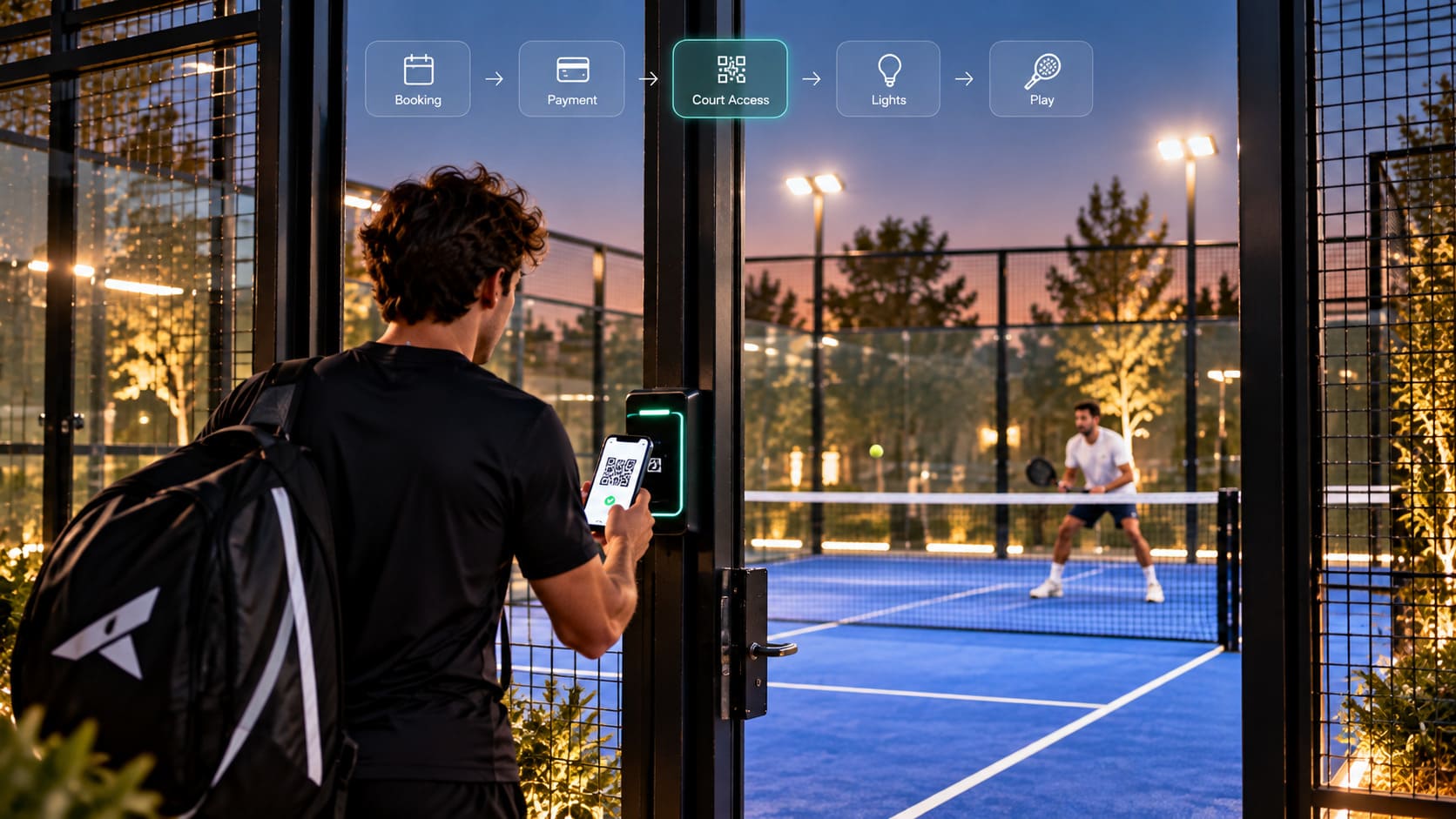
How Does Access Control Work for Padel Clubs? QR Codes, RFID, Smart Locks, Court Lighting, and Bookings Explained.

Oct 1, 2026
How to Drive Player Retention at Your Padel Club: Discover 10 Proven Strategies to Boost Court Bookings, Re-engage Members, and Grow Your Revenue.

See Doinsport in action
Ready to grow your padel or tennis club?
Join over 1,000 clubs that run on Doinsport. Book a free demo and see what it can do for your club.
We're here to help.


See Doinsport in action
Ready to grow your padel or tennis club?
Join over 1,000 clubs that run on Doinsport. Book a free demo and see what it can do for your club.
See Doinsport in action
Ready to grow your padel or tennis club?
Join over 1,000 clubs that run on Doinsport. Book a free demo and see what it can do for your club.
We're here to help.