
EN
EN
Padel
How to manage multiple padel clubs with a single software: A guide for networks and franchises
How to manage multiple padel clubs from a single software solution? Handle bookings, revenue, members, reporting, and a custom app for multi-site networks and franchises.

Are you already operating multiple padel clubs or preparing to open your second facility?
Moving from a single club to multiple locations rapidly changes how you manage your business.
Bookings, revenue, members, staff, inventory, memberships, pricing, payments: what was once easy to track at a single site becomes significantly more complex when each club operates with its own tools and siloed data.
At this stage, the challenge is no longer just finding a good booking software.
You need to centralize management across multiple padel clubs while retaining enough flexibility to adapt the operations of each individual facility.
In this guide, we will explore how multi-site management software works, the features that actually matter for a club network, and the common pitfalls to avoid as your business begins to scale.
Still searching for the right solution for your network? Check out our comparison of the best padel club management software.
What is multi-site management software for padel clubs?
Multi-site management software allows you to run multiple facilities from a single, unified environment.
Instead of having:
Club A → Software A → Customer Database A → Reporting A
Club B → Software B → Customer Database B → Reporting B
Club C → Software C → Customer Database C → Reporting C
you gradually centralize all network operations into a shared platform.
The goal is to be able to view the group's overall performance at a glance while still being able to analyze each facility individually.
A padel club management software built for multi-site operations must therefore address two seemingly contradictory needs:
centralizing overall management
while enabling
location-specific management for each club.
This balance becomes essential as a network starts to expand.
When is it time to switch to multi-site management?
You don't need to own ten facilities to feel the need.
This challenge often arises as soon as you open your second club.
With a single facility, managers usually have a direct, hands-on understanding of:
their booking schedule;
their staff;
their regular players;
their revenue;
their off-peak hours;
their memberships;
their inventory;
their daily operational challenges.
With two or three locations, maintaining this direct oversight becomes much more difficult.
Several signs indicate that switching to a centralized management system is necessary.
You are consolidating your numbers manually
Each club manager sends in their report.
The data is then compiled manually into Excel or Google Sheets.
The network manager spends hours verifying numbers before even beginning to analyze them.
This is usually the first red flag.
Each facility has its own player database
You have a player at your Montpellier location.
They then play at your Nîmes club.
Depending on your setup, you could end up with two separate profiles, split purchase histories, and a fragmented view of the same player.
Your customer data becomes increasingly siloed.
You are juggling multiple software logins
Each club has its own separate account.
Headquarters holds multiple logins.
Managers constantly switch between different dashboards.
And when a new club opens, you have to set everything up from scratch again.
You cannot easily compare your facilities
Which club has the highest occupancy rate?
Which location is growing its player base the fastest?
Where is the average spend per player highest?
Which club is optimizing off-peak hours most effectively?
Without centralized reporting, answering these questions requires multiple exports and tedious data processing.
Your teams use different operational processes
One club operates with one set of procedures.
The second uses another.
The third develops its own habits.
The larger the network grows, the harder it becomes to maintain consistent operational standards.
At this point, software becomes an essential tool to structure your network.
The 7 must-have features of multi-site software for padel
Not all club management software is designed to scale with a network.
Here are the features we consider absolutely critical.
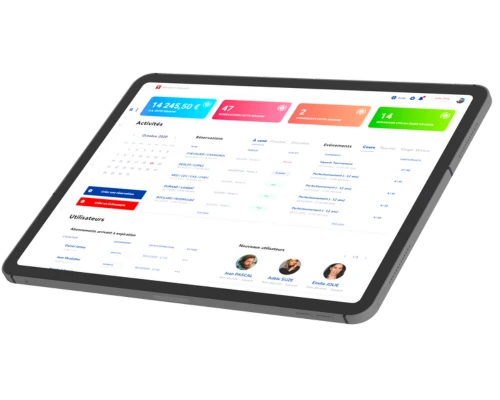
1. A consolidated dashboard
A network operator should not have to log into five different accounts to understand their business performance.
You must be able to view:
revenue;
bookings;
occupancy rates;
player numbers;
memberships;
payments;
pro-shop sales;
activity by location.
The ideal solution allows you to seamlessly drill down from:
Network View
to
Location View
and then run granular analyses by sport, court, or time slot.
Example
KPI | Montpellier Club | Nîmes Club | Avignon Club | Total Network |
|---|---|---|---|---|
Monthly Revenue | €95,000 | €72,000 | €63,000 | €230,000 |
Bookings | 3,100 | 2,350 | 2,050 | 7,500 |
Occupancy Rate | 76% | 71% | 64% | 71% |
Average Spend | €31 | €30 | €29 | €30.70 |
New Players | 210 | 175 | 148 | 533 |
While these numbers are illustrative, the principle is vital.
Your data must quickly answer two questions:
How is my overall network performing?
and
Which club requires my immediate attention?
2. Location-specific and consolidated reporting
Dashboards provide a real-time snapshot.
Reporting helps you understand long-term trends.
A club network needs to easily compare:
week-over-week;
month-over-month;
year-over-year;
location vs. location;
activity vs. activity.
The goal is not to generate more spreadsheets, but to quickly identify discrepancies.
Example
If two comparable clubs show:
Club A: 78% occupancy
Club B: 61% occupancy
the immediate question is:
Why?
Perhaps Club A has a more optimized pricing strategy.
Perhaps its social events and tournaments are more successful.
Perhaps its player acquisition is more effective.
Perhaps booking slots are configured differently.
Multi-site analytics allow you to turn your top-performing club into an internal benchmark for the entire network.
DoinSport integrates powerful statistics and reporting features directly into its padel club management software.
3. Centralized booking management
Court booking remains the operational heartbeat of any padel club.
Yet, within a network, each facility might operate differently:
number of courts;
slot durations;
opening hours;
rates;
off-peak hours;
sports and activities;
memberships;
cancellation policies.
Your software must centralize management without forcing every club into a rigid, identical setup.
For instance, a club in a major city center might require a different pricing structure than one in a smaller town.
Centralization does not mean total standardization.
It means all booking rules are controlled from a single, cohesive admin panel.
Discover how padel booking management works with DoinSport.
4. A network-wide, actionable player database
As your network expands, your player database becomes one of your most valuable assets.
Consider a group with:
5 clubs × 4,000 players = potentially 20,000 customer profiles.
This unified database helps you deeply analyze:
playing frequency;
preferred locations;
customer lifetime value;
membership status;
purchase history;
tournament participation;
recent activity.
A centralized database also enables highly targeted marketing segmentation.
Examples:
Players inactive for 60 days
→ win-back email campaign.
Regular players without a membership
→ upsell to a monthly membership.
Players visiting multiple facilities
→ promote a multi-club pass.
Players active in tournaments
→ priority invites to the next league event.
The benefits go far beyond daily operations.
Clean, centralized customer data is a powerful engine for retention and revenue growth.
5. Fine-grained user access control
As your network grows, not everyone should have access to everything.
A group director needs different metrics and permissions than a front-desk staff member.
A multi-site software must allow you to structure roles and permissions effectively.
Example of user hierarchy
Network Directors
→ full access to all clubs and consolidated financial reports.
Club Managers
→ access to their specific location's data.
Front-Desk Staff
→ daily bookings, point-of-sale, member check-ins, and daily operations.
Sales or Marketing Managers
→ access to customer data needed for campaigns and player engagement.
Coaches & Pros
→ access to information directly related to their lessons, clinics, and schedules.
Proper permission management ensures you maintain a shared platform without cluttering the interface for your team.
6. Location-specific POS and inventory management
A padel club network sells much more than court time.
Your clubs also generate significant revenue through:
food and beverage;
drinks;
apparel;
rackets;
balls;
accessories;
overgrips;
camps and clinics;
lessons;
corporate events;
memberships.
This quickly leads to a critical question:
How do we track exactly what is sold at each location?
Each club must be able to run its daily POS operations independently, while sending consolidated sales data back to headquarters.
The same applies to inventory.
If you operate multiple pro-shops, you need to track:
top-selling items;
low-stock warnings;
sales differences between clubs;
slow-moving stock;
overall stock valuation.
Centralizing this data dramatically simplifies your supply chain and purchasing decisions.
7. A seamless player experience across the network
Your internal operations might be complex, but the player experience must remain simple and seamless.
This is even more critical if all your clubs share the same brand.
Players expect a consistent journey:
unified brand identity;
intuitive booking process;
frictionless payments;
consistent communication;
easy navigation;
equivalent services.
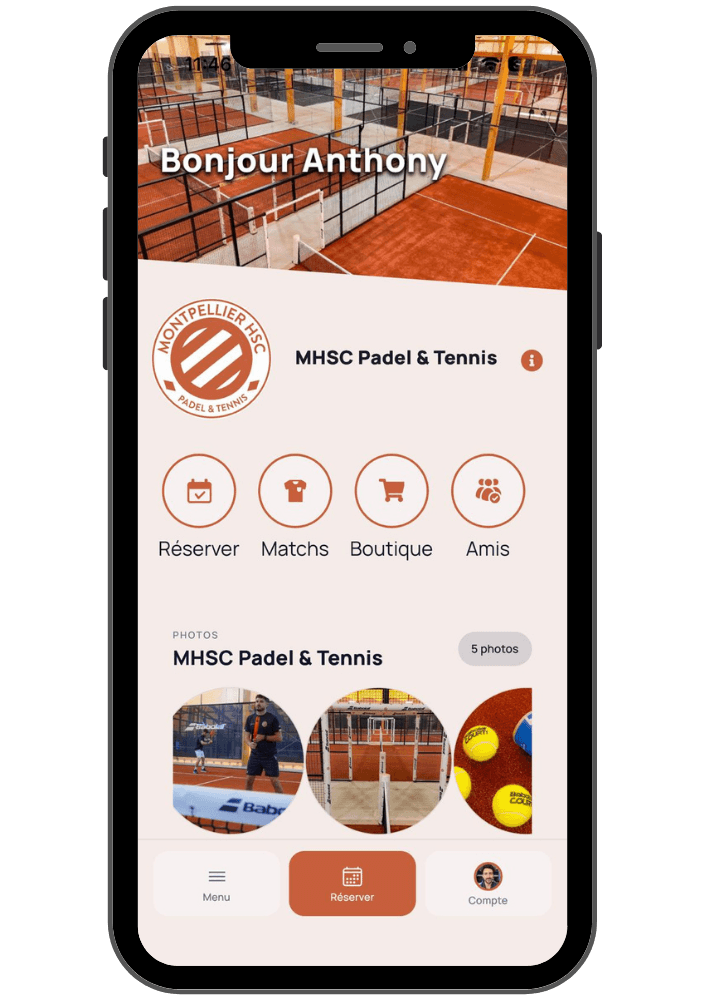
Your mobile app is the cornerstone of this customer journey.
A custom-branded padel club app keeps your brand front and center, rather than routing players through a third-party aggregator.
For a growing network, this is the ultimate way to build a brand that exists beyond any single location.
A single unified app or one app per club?
This is a strategic question when structuring a network.
The answer depends primarily on your brand architecture.
Scenario 1: All clubs share the same brand
Example:
Padel Network Montpellier
Padel Network Toulouse
Padel Network Bordeaux
It is highly recommended to build a unified app experience.
The player should immediately feel that they belong to a single ecosystem.
The network brand takes precedence over the individual venue.
Scenario 2: The group operates multiple distinct brands
A group may acquire or manage existing clubs while retaining their local identities and heritage.
In this case, it may be better to maintain separate player-facing app experiences while centralizing backend management for headquarters.
This is a crucial distinction to discuss with your software vendor before making a decision.
The question shouldn't just be:
"Do you provide a mobile app?"
But rather:
"How does your mobile app support a multi-site network structure?"
How to track performance across multiple padel clubs?
Operating multi-site software shifts your management style from intuition to data-driven decision-making.
Here are the KPIs we recommend tracking closely.
Revenue
Clearly essential.
But don't just look at the high-level revenue figures.
Analyze it by:
location;
sport/activity;
revenue stream (bar, pro-shop, bookings);
time of day/week;
customer segment.
Occupancy rate
This is arguably the most critical metric in the padel industry.
An unbooked court during a prime slot is lost inventory that can never be sold again.
Tracking occupancy rates across locations helps you instantly identify clubs with untapped growth potential.
Revenue per court
Two clubs might generate the exact same revenue but with a different number of courts.
Measuring revenue per court allows for a fair comparison of court yield and productivity.
Average spend per player
A club can boost profitability without necessarily booking more courts, simply by optimizing:
the pro-shop;
food and beverage;
memberships;
lessons;
tournaments & events;
in-app wallets.
Average spend helps you measure this ancillary revenue performance.
New players
Is your network continuously acquiring new customers?
At what rate?
Which locations are leading the charge?
Retention rate
Acquiring a player only to have them play once is expensive.
Player lifetime value and frequency of play are critical metrics to monitor.
Peak vs. off-peak ratio
Two clubs with the same overall occupancy rate might have completely different booking profiles.
One might only be busy in the evening.
The other may have successfully developed daytime off-peak bookings.
This data highlights best practices that can be replicated across other venues.
How to compare performance between different facilities?
Comparing raw revenue numbers rarely tells the whole story.
Consider this scenario:
Club A
8 courts
€100,000 monthly revenue
Club B
5 courts
€80,000 monthly revenue
Club A generates more revenue overall.
But look closely at the yield:
Revenue per court (Club A): €12,500
Revenue per court (Club B): €16,000
Club B is actually optimizing its court capacity much better.
This is exactly why multi-site reporting must compare performance ratios, not just absolute volumes.
Valuable metrics to compare include:
revenue per court;
bookings per court;
revenue per player;
revenue per available hour;
occupancy rate;
pro-shop spend per player;
membership conversion rate.
This analytical approach lets you identify the strategies of top-performing clubs and roll them out across your network.
How to manage different pricing across multiple clubs?
Centralization does not mean identical pricing.
A network can easily have different pricing tiers:
Club A
Peak rate: €36
Club B
Peak rate: €44
Club C
Peak rate: €52
These price variations are often driven by:
local rent and operational costs;
demographics;
local competition;
facility quality and premium amenities;
brand positioning;
local demand levels.
The same logic applies to off-peak slots.
A robust multi-site software must allow each club to maintain its own local pricing rules while managed under one parent account.
Headquarters can then measure how these pricing policies impact:
occupancy rate + average spend + revenue.
How to manage memberships across a padel network?
This is another great growth opportunity.
A club network can leverage several membership models.
Local Membership
The player only gets perks and booking rights at their home club.
Network Membership
The player can book and play across any club in your network.
Premium Membership
The player enjoys advanced benefits, such as:
priority booking windows;
discounted rates;
monthly booking credits;
pro-shop discounts;
exclusive, member-only tournaments;
complimentary amenities.
Offering network-wide memberships can be a major differentiator against single-location competitors.
Imagine a business traveler who regularly moves between Lyon, Paris, and Montpellier.
A single membership that unlocks play at all these locations significantly increases the perceived value of your brand.
Multi-site vs. Franchise: What is the difference?
While both models represent scaling businesses, their operational needs differ slightly.
Multi-site Corporate Group
A single corporation owns and directly controls all venues.
The management team can easily standardize:
software stack;
SOPs (Standard Operating Procedures);
financial reporting;
marketing campaigns;
customer experience.
Franchise Network
Each franchisee is an independent legal and financial entity.
The franchisor must maintain strict brand guidelines and quality control while giving the franchisee the tools to successfully run their business.
Here, software becomes highly strategic.
It helps standardize:
the player booking experience;
core packages & offerings;
financial insights;
performance reporting;
brand identity;
operational workflows.
The franchisor can monitor the network's overall health without micromanaging the day-to-day work of local managers.
Why use the same software across all clubs?
As a network grows through acquisition, it's tempting to let each club keep using its existing tools.
At first, this seems like the path of least resistance.
Club A is already up and running with its system.
Club B was just acquired and has its own.
Why disrupt them?
Because this operational debt becomes extremely expensive to maintain as you scale.
Imagine managing five clubs with three different software tools.
You quickly run into:
three different data formats;
three different admin dashboards;
fragmented reporting systems;
inconsistent booking paths for players;
siloed player databases;
multiple staff training processes;
different support teams to contact when things go wrong.
Every data consolidation effort becomes a major project.
Migrating to a unified platform builds a powerful, scalable operating system for your entire network.
Should you completely centralize all operations?
Not necessarily.
The best approach is usually to:
Centralize core network functions
For example:
customer data;
consolidated financial reporting;
brand guidelines;
quality standards;
software tools;
high-level performance tracking;
core operational processes.
Empower local managers where they add unique value
For example:
local pricing adjustments;
social events and tournaments;
local community building;
opening hours adjustment;
targeted local promotions;
local social media communication.
A club located in Lille operates in a different local market than a club in Nice.
The right multi-site software should never make your business rigid.
It should enable centralized oversight without sacrificing local agility.
What if your clubs offer multiple sports?
This is where things get even more interesting.
A multi-site network might run diverse facilities:
Club A: Padel only
Club B: Padel + Pickleball
Club C: Padel + Tennis + Squash
Club D: Padel + Fitness
Using different software programs for each sport fragments your data even further.
A multi-sport solution brings everything together:
court/field schedules;
memberships;
activities;
bookings;
payments;
reporting.
DoinSport is specifically designed to manage multiple sports and activity types from a single, unified platform.
Explore our management solution for multi-sport facilities.
How to manage multiple clubs remotely?
Multi-site ownership means you can no longer be physically present at every club daily.
You must be able to monitor operations remotely.
Your software should let you easily track:
live court activity;
real-time bookings;
live sales;
payments and payouts;
customer profiles;
performance metrics;
alerts or transaction anomalies.
Automation can take remote management even further.
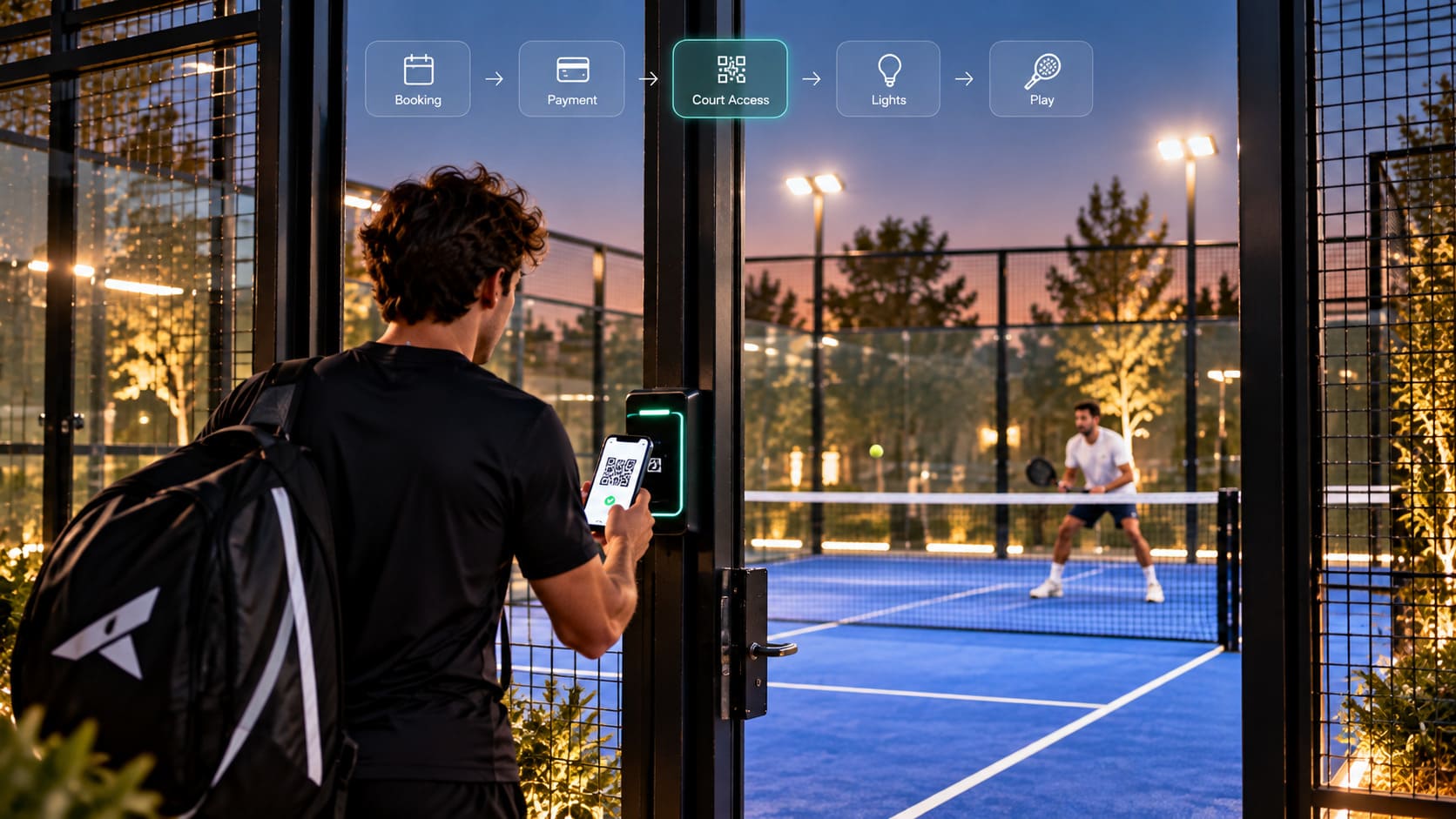
For some clubs, booking, payments, and facility access can be fully integrated.
The player books their court, pays online, and automatically receives an access code to enter the club or turn on court lights, without requiring front-desk staff.
For clubs where this automated model fits, learn more about smart, autonomous padel court technology.
How much does multi-site padel management software cost?
Pricing naturally depends on:
the number of locations;
the number of courts;
required features;
POS modules;
custom mobile apps;
reporting & BI needs;
user accounts;
hardware integrations;
onboarding and customer support.
But for a club network, the calculation should go beyond the licensing cost.
Imagine centralization saves you just:
2 hours of manual reporting per week, per club.
For a 10-club network, that is:
20 hours saved every single week.
Over the course of a year:
20 × 52 = 1,040 hours of manual labor eliminated.
The real question shifts from:
"How much does the software cost?"
to:
"How much is a lack of centralized tools costing us right now?"
We have compiled a complete pricing guide on this topic:
👉 How much does padel club management software actually cost?
You can also view DoinSport's pricing plans directly.
Should you switch software when opening your second club?
Not necessarily.
But this is the ideal time to evaluate your tech stack.
Your current software might have worked perfectly when managing a single location.
But your next phase of growth requires different capabilities.
Ask yourself:
Can it scale to manage multiple locations under one login?
Can I run side-by-side performance comparisons?
Can I set custom permissions for my staff?
Can I instantly consolidate network-wide data?
Can I maintain distinct booking and pricing rules per club?
Will this platform still support us when we grow to 5 or 10 locations?
The worst-case scenario is waiting until you have five locations to realize your current software cannot support your business growth.
If you are planning a software migration, check out our guide:
👉 How to change your padel club management software
12 questions to ask before choosing a multi-site management system
Before partnering with a software provider, ask their sales team:
Can I manage all my locations from a single dashboard?
Can I view consolidated network revenue?
Can I analyze each club's metrics individually?
Can I maintain location-specific pricing structures?
How are customer profiles synchronized across clubs?
How do user permissions and staff roles work?
Can the software handle multi-sport scheduling and booking?
How does the custom-branded app work for a multi-site brand?
Are POS and inventory tracked separately per location?
What is the onboarding process for adding a new location?
How does pricing scale as we open more sites?
What level of support and account management is provided during deployment?
The answers to these questions will quickly help you distinguish basic club software from a truly enterprise-ready solution designed for scaling networks.
Is DoinSport suitable for padel club networks?
DoinSport is built to power both independent clubs and complex multi-site operations.
The platform centralizes the key operational pillars of modern clubs:
bookings & court scheduling;
membership management;
integrated payments;
point of sale (POS);
custom-branded mobile apps;
business intelligence & reporting;
marketing & customer communication;
pro-shop inventory;
automated access control;
multi-sport management.
For a growing network, the goal is to establish a unified system that manages multiple locations without multiplying administrative tools.
DoinSport is already the trusted operating system for leading multi-site club groups.
For instance, All In Padel relies on a white-labeled version of DoinSport across its 10 facilities in France to centralize bookings, POS, customer loyalty programs, match organization, and corporate events.
To learn more about our complete feature set:
👉 DoinSport management software for padel clubs
Are you preparing to open your second club?
This is the perfect time to evaluate and optimize your software architecture.
Don't wait until you are managing five clubs.
The systems you put in place as you scale from 1 to 2 locations will determine how smoothly you can grow from:
2 → 5 → 10 → 20 locations.
The ultimate goal isn't just to digitalize your operations—it's to build a robust, scalable infrastructure that fuels your network's expansion.
👉 Book a live DoinSport demo today
FAQ — Multi-site management for padel clubs
What is multi-site management software for padel clubs?
It is a platform that allows you to manage multiple padel clubs from a single parent account. It centralizes player data, bookings, and financial reporting while allowing detailed tracking for each individual location.
When should we switch to a multi-site software?
The need usually arises as soon as you open a second club. As your network grows, centralizing player data, reporting, and operating procedures becomes critical to maintaining control.
Can we set different prices at each club?
Yes. A network often needs to adapt its pricing based on local market dynamics, local competition, and rent. Make sure your chosen software allows for location-specific pricing rules.
Can we manage multiple sports with the same platform?
Yes, advanced multi-sport solutions let you manage padel, tennis, squash, and pickleball under one unified dashboard. This is highly beneficial for operators with diverse facility concepts.
Which KPIs are most important for a padel club network?
Key metrics include overall revenue, court occupancy rates, revenue per court, average spend per player, new player acquisition, player retention, and individual facility performance.
Can you run a padel franchise using multi-site software?
Absolutely. A multi-site solution gives the franchisor a high-level consolidated view of the network while providing franchisees and local managers with dedicated access to run their own facilities.
What is the main benefit of a centralized player database?
It enhances customer insight, simplifies reporting, and boosts marketing efficiency. Most importantly, it keeps your customer data unified rather than scattered across disconnected systems.
Can we manage multiple padel clubs remotely?
Yes. Centralized software allows you to monitor bookings, sales, and key indicators in real time from anywhere. Combining this with automated access control integrations lets you run parts of your facilities fully automated.
How much does multi-site padel software cost?
The cost depends on the number of locations and features required. When evaluating, consider both the subscription cost and the significant operational savings gained from centralized workflows. Check out our guide on padel club management software pricing.
Is DoinSport built for padel networks and franchises?
Yes. DoinSport is designed to support both independent clubs and expanding multi-site brands, centralizing all key management workflows into a single system.
Summary
When you scale from a single club to a multi-site network, your software has to scale with you.
The key capabilities you need are:
consolidated reporting + centralized data + local flexibility + role-based permissions + a unified player journey.
The right multi-site software should instantly answer two essential questions:
How is my overall network performing?
and
Which club needs operational optimization?
Whether you are gearing up to open your second location or already running a multi-club network, DoinSport helps centralize your operations and build a foundation for your next stage of growth.
Are you already operating multiple padel clubs or preparing to open your second facility?
Moving from a single club to multiple locations rapidly changes how you manage your business.
Bookings, revenue, members, staff, inventory, memberships, pricing, payments: what was once easy to track at a single site becomes significantly more complex when each club operates with its own tools and siloed data.
At this stage, the challenge is no longer just finding a good booking software.
You need to centralize management across multiple padel clubs while retaining enough flexibility to adapt the operations of each individual facility.
In this guide, we will explore how multi-site management software works, the features that actually matter for a club network, and the common pitfalls to avoid as your business begins to scale.
Still searching for the right solution for your network? Check out our comparison of the best padel club management software.
What is multi-site management software for padel clubs?
Multi-site management software allows you to run multiple facilities from a single, unified environment.
Instead of having:
Club A → Software A → Customer Database A → Reporting A
Club B → Software B → Customer Database B → Reporting B
Club C → Software C → Customer Database C → Reporting C
you gradually centralize all network operations into a shared platform.
The goal is to be able to view the group's overall performance at a glance while still being able to analyze each facility individually.
A padel club management software built for multi-site operations must therefore address two seemingly contradictory needs:
centralizing overall management
while enabling
location-specific management for each club.
This balance becomes essential as a network starts to expand.
When is it time to switch to multi-site management?
You don't need to own ten facilities to feel the need.
This challenge often arises as soon as you open your second club.
With a single facility, managers usually have a direct, hands-on understanding of:
their booking schedule;
their staff;
their regular players;
their revenue;
their off-peak hours;
their memberships;
their inventory;
their daily operational challenges.
With two or three locations, maintaining this direct oversight becomes much more difficult.
Several signs indicate that switching to a centralized management system is necessary.
You are consolidating your numbers manually
Each club manager sends in their report.
The data is then compiled manually into Excel or Google Sheets.
The network manager spends hours verifying numbers before even beginning to analyze them.
This is usually the first red flag.
Each facility has its own player database
You have a player at your Montpellier location.
They then play at your Nîmes club.
Depending on your setup, you could end up with two separate profiles, split purchase histories, and a fragmented view of the same player.
Your customer data becomes increasingly siloed.
You are juggling multiple software logins
Each club has its own separate account.
Headquarters holds multiple logins.
Managers constantly switch between different dashboards.
And when a new club opens, you have to set everything up from scratch again.
You cannot easily compare your facilities
Which club has the highest occupancy rate?
Which location is growing its player base the fastest?
Where is the average spend per player highest?
Which club is optimizing off-peak hours most effectively?
Without centralized reporting, answering these questions requires multiple exports and tedious data processing.
Your teams use different operational processes
One club operates with one set of procedures.
The second uses another.
The third develops its own habits.
The larger the network grows, the harder it becomes to maintain consistent operational standards.
At this point, software becomes an essential tool to structure your network.
The 7 must-have features of multi-site software for padel
Not all club management software is designed to scale with a network.
Here are the features we consider absolutely critical.
1. A consolidated dashboard
A network operator should not have to log into five different accounts to understand their business performance.
You must be able to view:
revenue;
bookings;
occupancy rates;
player numbers;
memberships;
payments;
pro-shop sales;
activity by location.
The ideal solution allows you to seamlessly drill down from:
Network View
to
Location View
and then run granular analyses by sport, court, or time slot.
Example
KPI | Montpellier Club | Nîmes Club | Avignon Club | Total Network |
|---|---|---|---|---|
Monthly Revenue | €95,000 | €72,000 | €63,000 | €230,000 |
Bookings | 3,100 | 2,350 | 2,050 | 7,500 |
Occupancy Rate | 76% | 71% | 64% | 71% |
Average Spend | €31 | €30 | €29 | €30.70 |
New Players | 210 | 175 | 148 | 533 |
While these numbers are illustrative, the principle is vital.
Your data must quickly answer two questions:
How is my overall network performing?
and
Which club requires my immediate attention?
2. Location-specific and consolidated reporting
Dashboards provide a real-time snapshot.
Reporting helps you understand long-term trends.
A club network needs to easily compare:
week-over-week;
month-over-month;
year-over-year;
location vs. location;
activity vs. activity.
The goal is not to generate more spreadsheets, but to quickly identify discrepancies.
Example
If two comparable clubs show:
Club A: 78% occupancy
Club B: 61% occupancy
the immediate question is:
Why?
Perhaps Club A has a more optimized pricing strategy.
Perhaps its social events and tournaments are more successful.
Perhaps its player acquisition is more effective.
Perhaps booking slots are configured differently.
Multi-site analytics allow you to turn your top-performing club into an internal benchmark for the entire network.
DoinSport integrates powerful statistics and reporting features directly into its padel club management software.
3. Centralized booking management
Court booking remains the operational heartbeat of any padel club.
Yet, within a network, each facility might operate differently:
number of courts;
slot durations;
opening hours;
rates;
off-peak hours;
sports and activities;
memberships;
cancellation policies.
Your software must centralize management without forcing every club into a rigid, identical setup.
For instance, a club in a major city center might require a different pricing structure than one in a smaller town.
Centralization does not mean total standardization.
It means all booking rules are controlled from a single, cohesive admin panel.
Discover how padel booking management works with DoinSport.
4. A network-wide, actionable player database
As your network expands, your player database becomes one of your most valuable assets.
Consider a group with:
5 clubs × 4,000 players = potentially 20,000 customer profiles.
This unified database helps you deeply analyze:
playing frequency;
preferred locations;
customer lifetime value;
membership status;
purchase history;
tournament participation;
recent activity.
A centralized database also enables highly targeted marketing segmentation.
Examples:
Players inactive for 60 days
→ win-back email campaign.
Regular players without a membership
→ upsell to a monthly membership.
Players visiting multiple facilities
→ promote a multi-club pass.
Players active in tournaments
→ priority invites to the next league event.
The benefits go far beyond daily operations.
Clean, centralized customer data is a powerful engine for retention and revenue growth.
5. Fine-grained user access control
As your network grows, not everyone should have access to everything.
A group director needs different metrics and permissions than a front-desk staff member.
A multi-site software must allow you to structure roles and permissions effectively.
Example of user hierarchy
Network Directors
→ full access to all clubs and consolidated financial reports.
Club Managers
→ access to their specific location's data.
Front-Desk Staff
→ daily bookings, point-of-sale, member check-ins, and daily operations.
Sales or Marketing Managers
→ access to customer data needed for campaigns and player engagement.
Coaches & Pros
→ access to information directly related to their lessons, clinics, and schedules.
Proper permission management ensures you maintain a shared platform without cluttering the interface for your team.
6. Location-specific POS and inventory management
A padel club network sells much more than court time.
Your clubs also generate significant revenue through:
food and beverage;
drinks;
apparel;
rackets;
balls;
accessories;
overgrips;
camps and clinics;
lessons;
corporate events;
memberships.
This quickly leads to a critical question:
How do we track exactly what is sold at each location?
Each club must be able to run its daily POS operations independently, while sending consolidated sales data back to headquarters.
The same applies to inventory.
If you operate multiple pro-shops, you need to track:
top-selling items;
low-stock warnings;
sales differences between clubs;
slow-moving stock;
overall stock valuation.
Centralizing this data dramatically simplifies your supply chain and purchasing decisions.
7. A seamless player experience across the network
Your internal operations might be complex, but the player experience must remain simple and seamless.
This is even more critical if all your clubs share the same brand.
Players expect a consistent journey:
unified brand identity;
intuitive booking process;
frictionless payments;
consistent communication;
easy navigation;
equivalent services.
Your mobile app is the cornerstone of this customer journey.
A custom-branded padel club app keeps your brand front and center, rather than routing players through a third-party aggregator.
For a growing network, this is the ultimate way to build a brand that exists beyond any single location.
A single unified app or one app per club?
This is a strategic question when structuring a network.
The answer depends primarily on your brand architecture.
Scenario 1: All clubs share the same brand
Example:
Padel Network Montpellier
Padel Network Toulouse
Padel Network Bordeaux
It is highly recommended to build a unified app experience.
The player should immediately feel that they belong to a single ecosystem.
The network brand takes precedence over the individual venue.
Scenario 2: The group operates multiple distinct brands
A group may acquire or manage existing clubs while retaining their local identities and heritage.
In this case, it may be better to maintain separate player-facing app experiences while centralizing backend management for headquarters.
This is a crucial distinction to discuss with your software vendor before making a decision.
The question shouldn't just be:
"Do you provide a mobile app?"
But rather:
"How does your mobile app support a multi-site network structure?"
How to track performance across multiple padel clubs?
Operating multi-site software shifts your management style from intuition to data-driven decision-making.
Here are the KPIs we recommend tracking closely.
Revenue
Clearly essential.
But don't just look at the high-level revenue figures.
Analyze it by:
location;
sport/activity;
revenue stream (bar, pro-shop, bookings);
time of day/week;
customer segment.
Occupancy rate
This is arguably the most critical metric in the padel industry.
An unbooked court during a prime slot is lost inventory that can never be sold again.
Tracking occupancy rates across locations helps you instantly identify clubs with untapped growth potential.
Revenue per court
Two clubs might generate the exact same revenue but with a different number of courts.
Measuring revenue per court allows for a fair comparison of court yield and productivity.
Average spend per player
A club can boost profitability without necessarily booking more courts, simply by optimizing:
the pro-shop;
food and beverage;
memberships;
lessons;
tournaments & events;
in-app wallets.
Average spend helps you measure this ancillary revenue performance.
New players
Is your network continuously acquiring new customers?
At what rate?
Which locations are leading the charge?
Retention rate
Acquiring a player only to have them play once is expensive.
Player lifetime value and frequency of play are critical metrics to monitor.
Peak vs. off-peak ratio
Two clubs with the same overall occupancy rate might have completely different booking profiles.
One might only be busy in the evening.
The other may have successfully developed daytime off-peak bookings.
This data highlights best practices that can be replicated across other venues.
How to compare performance between different facilities?
Comparing raw revenue numbers rarely tells the whole story.
Consider this scenario:
Club A
8 courts
€100,000 monthly revenue
Club B
5 courts
€80,000 monthly revenue
Club A generates more revenue overall.
But look closely at the yield:
Revenue per court (Club A): €12,500
Revenue per court (Club B): €16,000
Club B is actually optimizing its court capacity much better.
This is exactly why multi-site reporting must compare performance ratios, not just absolute volumes.
Valuable metrics to compare include:
revenue per court;
bookings per court;
revenue per player;
revenue per available hour;
occupancy rate;
pro-shop spend per player;
membership conversion rate.
This analytical approach lets you identify the strategies of top-performing clubs and roll them out across your network.
How to manage different pricing across multiple clubs?
Centralization does not mean identical pricing.
A network can easily have different pricing tiers:
Club A
Peak rate: €36
Club B
Peak rate: €44
Club C
Peak rate: €52
These price variations are often driven by:
local rent and operational costs;
demographics;
local competition;
facility quality and premium amenities;
brand positioning;
local demand levels.
The same logic applies to off-peak slots.
A robust multi-site software must allow each club to maintain its own local pricing rules while managed under one parent account.
Headquarters can then measure how these pricing policies impact:
occupancy rate + average spend + revenue.
How to manage memberships across a padel network?
This is another great growth opportunity.
A club network can leverage several membership models.
Local Membership
The player only gets perks and booking rights at their home club.
Network Membership
The player can book and play across any club in your network.
Premium Membership
The player enjoys advanced benefits, such as:
priority booking windows;
discounted rates;
monthly booking credits;
pro-shop discounts;
exclusive, member-only tournaments;
complimentary amenities.
Offering network-wide memberships can be a major differentiator against single-location competitors.
Imagine a business traveler who regularly moves between Lyon, Paris, and Montpellier.
A single membership that unlocks play at all these locations significantly increases the perceived value of your brand.
Multi-site vs. Franchise: What is the difference?
While both models represent scaling businesses, their operational needs differ slightly.
Multi-site Corporate Group
A single corporation owns and directly controls all venues.
The management team can easily standardize:
software stack;
SOPs (Standard Operating Procedures);
financial reporting;
marketing campaigns;
customer experience.
Franchise Network
Each franchisee is an independent legal and financial entity.
The franchisor must maintain strict brand guidelines and quality control while giving the franchisee the tools to successfully run their business.
Here, software becomes highly strategic.
It helps standardize:
the player booking experience;
core packages & offerings;
financial insights;
performance reporting;
brand identity;
operational workflows.
The franchisor can monitor the network's overall health without micromanaging the day-to-day work of local managers.
Why use the same software across all clubs?
As a network grows through acquisition, it's tempting to let each club keep using its existing tools.
At first, this seems like the path of least resistance.
Club A is already up and running with its system.
Club B was just acquired and has its own.
Why disrupt them?
Because this operational debt becomes extremely expensive to maintain as you scale.
Imagine managing five clubs with three different software tools.
You quickly run into:
three different data formats;
three different admin dashboards;
fragmented reporting systems;
inconsistent booking paths for players;
siloed player databases;
multiple staff training processes;
different support teams to contact when things go wrong.
Every data consolidation effort becomes a major project.
Migrating to a unified platform builds a powerful, scalable operating system for your entire network.
Should you completely centralize all operations?
Not necessarily.
The best approach is usually to:
Centralize core network functions
For example:
customer data;
consolidated financial reporting;
brand guidelines;
quality standards;
software tools;
high-level performance tracking;
core operational processes.
Empower local managers where they add unique value
For example:
local pricing adjustments;
social events and tournaments;
local community building;
opening hours adjustment;
targeted local promotions;
local social media communication.
A club located in Lille operates in a different local market than a club in Nice.
The right multi-site software should never make your business rigid.
It should enable centralized oversight without sacrificing local agility.
What if your clubs offer multiple sports?
This is where things get even more interesting.
A multi-site network might run diverse facilities:
Club A: Padel only
Club B: Padel + Pickleball
Club C: Padel + Tennis + Squash
Club D: Padel + Fitness
Using different software programs for each sport fragments your data even further.
A multi-sport solution brings everything together:
court/field schedules;
memberships;
activities;
bookings;
payments;
reporting.
DoinSport is specifically designed to manage multiple sports and activity types from a single, unified platform.
Explore our management solution for multi-sport facilities.
How to manage multiple clubs remotely?
Multi-site ownership means you can no longer be physically present at every club daily.
You must be able to monitor operations remotely.
Your software should let you easily track:
live court activity;
real-time bookings;
live sales;
payments and payouts;
customer profiles;
performance metrics;
alerts or transaction anomalies.
Automation can take remote management even further.
For some clubs, booking, payments, and facility access can be fully integrated.
The player books their court, pays online, and automatically receives an access code to enter the club or turn on court lights, without requiring front-desk staff.
For clubs where this automated model fits, learn more about smart, autonomous padel court technology.
How much does multi-site padel management software cost?
Pricing naturally depends on:
the number of locations;
the number of courts;
required features;
POS modules;
custom mobile apps;
reporting & BI needs;
user accounts;
hardware integrations;
onboarding and customer support.
But for a club network, the calculation should go beyond the licensing cost.
Imagine centralization saves you just:
2 hours of manual reporting per week, per club.
For a 10-club network, that is:
20 hours saved every single week.
Over the course of a year:
20 × 52 = 1,040 hours of manual labor eliminated.
The real question shifts from:
"How much does the software cost?"
to:
"How much is a lack of centralized tools costing us right now?"
We have compiled a complete pricing guide on this topic:
👉 How much does padel club management software actually cost?
You can also view DoinSport's pricing plans directly.
Should you switch software when opening your second club?
Not necessarily.
But this is the ideal time to evaluate your tech stack.
Your current software might have worked perfectly when managing a single location.
But your next phase of growth requires different capabilities.
Ask yourself:
Can it scale to manage multiple locations under one login?
Can I run side-by-side performance comparisons?
Can I set custom permissions for my staff?
Can I instantly consolidate network-wide data?
Can I maintain distinct booking and pricing rules per club?
Will this platform still support us when we grow to 5 or 10 locations?
The worst-case scenario is waiting until you have five locations to realize your current software cannot support your business growth.
If you are planning a software migration, check out our guide:
👉 How to change your padel club management software
12 questions to ask before choosing a multi-site management system
Before partnering with a software provider, ask their sales team:
Can I manage all my locations from a single dashboard?
Can I view consolidated network revenue?
Can I analyze each club's metrics individually?
Can I maintain location-specific pricing structures?
How are customer profiles synchronized across clubs?
How do user permissions and staff roles work?
Can the software handle multi-sport scheduling and booking?
How does the custom-branded app work for a multi-site brand?
Are POS and inventory tracked separately per location?
What is the onboarding process for adding a new location?
How does pricing scale as we open more sites?
What level of support and account management is provided during deployment?
The answers to these questions will quickly help you distinguish basic club software from a truly enterprise-ready solution designed for scaling networks.
Is DoinSport suitable for padel club networks?
DoinSport is built to power both independent clubs and complex multi-site operations.
The platform centralizes the key operational pillars of modern clubs:
bookings & court scheduling;
membership management;
integrated payments;
point of sale (POS);
custom-branded mobile apps;
business intelligence & reporting;
marketing & customer communication;
pro-shop inventory;
automated access control;
multi-sport management.
For a growing network, the goal is to establish a unified system that manages multiple locations without multiplying administrative tools.
DoinSport is already the trusted operating system for leading multi-site club groups.
For instance, All In Padel relies on a white-labeled version of DoinSport across its 10 facilities in France to centralize bookings, POS, customer loyalty programs, match organization, and corporate events.
To learn more about our complete feature set:
👉 DoinSport management software for padel clubs
Are you preparing to open your second club?
This is the perfect time to evaluate and optimize your software architecture.
Don't wait until you are managing five clubs.
The systems you put in place as you scale from 1 to 2 locations will determine how smoothly you can grow from:
2 → 5 → 10 → 20 locations.
The ultimate goal isn't just to digitalize your operations—it's to build a robust, scalable infrastructure that fuels your network's expansion.
👉 Book a live DoinSport demo today
FAQ — Multi-site management for padel clubs
What is multi-site management software for padel clubs?
It is a platform that allows you to manage multiple padel clubs from a single parent account. It centralizes player data, bookings, and financial reporting while allowing detailed tracking for each individual location.
When should we switch to a multi-site software?
The need usually arises as soon as you open a second club. As your network grows, centralizing player data, reporting, and operating procedures becomes critical to maintaining control.
Can we set different prices at each club?
Yes. A network often needs to adapt its pricing based on local market dynamics, local competition, and rent. Make sure your chosen software allows for location-specific pricing rules.
Can we manage multiple sports with the same platform?
Yes, advanced multi-sport solutions let you manage padel, tennis, squash, and pickleball under one unified dashboard. This is highly beneficial for operators with diverse facility concepts.
Which KPIs are most important for a padel club network?
Key metrics include overall revenue, court occupancy rates, revenue per court, average spend per player, new player acquisition, player retention, and individual facility performance.
Can you run a padel franchise using multi-site software?
Absolutely. A multi-site solution gives the franchisor a high-level consolidated view of the network while providing franchisees and local managers with dedicated access to run their own facilities.
What is the main benefit of a centralized player database?
It enhances customer insight, simplifies reporting, and boosts marketing efficiency. Most importantly, it keeps your customer data unified rather than scattered across disconnected systems.
Can we manage multiple padel clubs remotely?
Yes. Centralized software allows you to monitor bookings, sales, and key indicators in real time from anywhere. Combining this with automated access control integrations lets you run parts of your facilities fully automated.
How much does multi-site padel software cost?
The cost depends on the number of locations and features required. When evaluating, consider both the subscription cost and the significant operational savings gained from centralized workflows. Check out our guide on padel club management software pricing.
Is DoinSport built for padel networks and franchises?
Yes. DoinSport is designed to support both independent clubs and expanding multi-site brands, centralizing all key management workflows into a single system.
Summary
When you scale from a single club to a multi-site network, your software has to scale with you.
The key capabilities you need are:
consolidated reporting + centralized data + local flexibility + role-based permissions + a unified player journey.
The right multi-site software should instantly answer two essential questions:
How is my overall network performing?
and
Which club needs operational optimization?
Whether you are gearing up to open your second location or already running a multi-club network, DoinSport helps centralize your operations and build a foundation for your next stage of growth.
Similar articles
Oct 14, 2026
How Does Access Control Work for Padel Clubs? QR Codes, RFID, Smart Locks, Court Lighting, and Bookings Explained.

Oct 1, 2026
How to Drive Player Retention at Your Padel Club: Discover 10 Proven Strategies to Boost Court Bookings, Re-engage Members, and Grow Your Revenue.

See Doinsport in action
Ready to grow your padel or tennis club?
Join over 1,000 clubs that run on Doinsport. Book a free demo and see what it can do for your club.
We're here to help.



See Doinsport in action
Ready to grow your padel or tennis club?
Join over 1,000 clubs that run on Doinsport. Book a free demo and see what it can do for your club.
See Doinsport in action
Ready to grow your padel or tennis club?
Join over 1,000 clubs that run on Doinsport. Book a free demo and see what it can do for your club.
We're here to help.