
Padel
How much does padel club management software cost in 2026? Pricing, commissions, and hidden fees
Discover the true cost of padel club management software in 2026: subscriptions, transaction fees, payments, and hidden costs to watch out for.

How much does it actually cost to equip a padel club with management software?
The answer is less straightforward than a simple monthly price tag.
Between the software subscription, online payment fees, potential commissions, mobile app, POS system, access control, hardware, and the time spent by your team, two solutions with a similar price tag can actually end up having vastly different costs.
For a padel club, the monthly software fee is therefore not the only metric you should look at.
You need to consider its total cost of ownership, also known as TCO, as well as the revenue and efficiency gains it generates: saved admin time, additional bookings, automation, and player loyalty.
In this guide, we will break down the main costs to keep in mind for 2026 and give you a simple framework to compare different management software options objectively.
Still comparing the different solutions on the market? Check out our comparison of the best padel club management software in 2026.
How much does padel club management software cost?
There is no single pricing plan that fits all clubs.
The price mainly depends on:
the number of courts;
the number of locations;
the features you use;
whether you want a custom-branded mobile app;
the POS system;
online payments;
access control;
automated court lighting;
the level of onboarding and customer support;
the specific needs of your club.
Software providers also use different pricing models.
Flat-rate monthly subscription
This is the most straightforward model to understand.
The club pays a fixed monthly subscription to access the software and the features included in their plan.
The main benefit is budget predictability.
If your bookings and revenue grow significantly, your software costs do not necessarily increase at the same pace.
Structure-based pricing
Some solutions scale their pricing based on:
the number of courts;
the number of clubs;
the number of users;
activated features;
the type of facility.
Naturally, a small community club does not have the same requirements as a franchise network operating fifteen locations.
Add-ons and options
An entry-level price might only cover basic features.
Other modules may be billed separately:
POS system;
custom-branded app;
access control;
automated lighting;
website creation;
payment terminals;
advanced analytics and reporting;
multi-site management features.
It is therefore crucial to compare what is actually included in your specific configuration.
Transaction or booking fees
Finally, some platforms and providers charge fees based on your business volume:
payment processing fees;
commissions;
service fees;
per-booking fees;
fees charged to either the club or the player.
This model can seem cost-effective when a club first opens.
However, as booking volumes grow, it is essential to calculate the real financial impact.
The 7 key costs to compare before choosing a padel software
To accurately compare two solutions, ask for a detailed quote covering these seven key areas.
1. The software subscription
This is the most visible part.
Your management software should ideally cover all essential club operations:
scheduling and court sheets;
bookings and reservations;
membership management;
subscriptions;
payments;
customer communication;
reporting and analytics.
An all-in-one platform might have a slightly higher subscription fee but will replace several single-use tools that you currently pay for separately.
That is why comparing monthly subscriptions alone rarely gives you a clear picture of the actual cost.
To understand what an all-in-one tool can centralize, discover our padel club management software.
2. Online payment processing fees
These are often overlooked during the buying process.
Yet, as soon as a player books and pays online via your website or app, a payment gateway handles the transaction.
These fees typically depend on:
the transaction volume;
the card type (debit, credit, premium);
the card's country of origin;
the payment method;
the payment gateway provider.
With DoinSport, online payments can be centralized via Stripe for court bookings, memberships, and pro shop purchases.
The goal is not to find a "zero fee" system, but rather to understand:
How much does it actually cost me to process $100 in revenue?
And, more importantly, to balance this cost against the benefits of online payments:
fewer unpaid balances and no-shows;
instant booking confirmations;
fewer manual admin tasks;
split payments among players;
recurring revenue through automated subscriptions.
To learn more, check out our online payment solutions for padel clubs.
3. Commissions and booking fees
This is a critical factor for clubs with high occupancy rates.
Let’s look at a hypothetical club with:
6 courts;
6 bookings per court per day;
an average booking value of $30;
30 days of operation per month.
The monthly booking revenue would be around:
6 courts × 6 bookings × 30 days × $30 = $32,400 per month.
With this level of activity, a seemingly small difference in variable fees can quickly add up to a significant amount over the year.
For instance, a 1% fee on $32,400 represents $324 per month, or $3,888 per year.
At 2%, the impact climbs to:
$648 per month, or $7,776 per year.
This does not mean a commission-based model is always a bad choice.
A marketplace platform that actively brings new players to your club can justify part of this cost.
However, you must distinguish between two things:
the cost of acquiring new players
and
the fees applied to players who would have booked with you anyway.
To understand the difference between SaaS management software and consumer marketplaces, read our guide: Playtomic Alternative: Which management software should you choose for your padel club?.
Flat-rate subscription vs. Commission: Which model is more profitable?
There is no one-size-fits-all answer.
It all depends on your club's stage of growth.
For a brand-new club
A consumer marketplace can be highly beneficial if it helps solve your primary challenge:
finding players and filling empty courts.
In this scenario, commission fees can be considered a marketing and acquisition cost.
For an established club
The equation changes when you already have:
a solid base of active members;
a strong local community;
a high court occupancy rate;
a recognized local brand;
thousands of recurring bookings.
At this stage, variable commission fees become a heavy burden.
As your revenue grows, it becomes critical to calculate:
Software Cost / Revenue generated from bookings
and
Variable fees / Total processed revenue.
A mature club will also want to own its customer relationships directly, rather than funneling players to a third-party marketplace app where competitors are also listed.
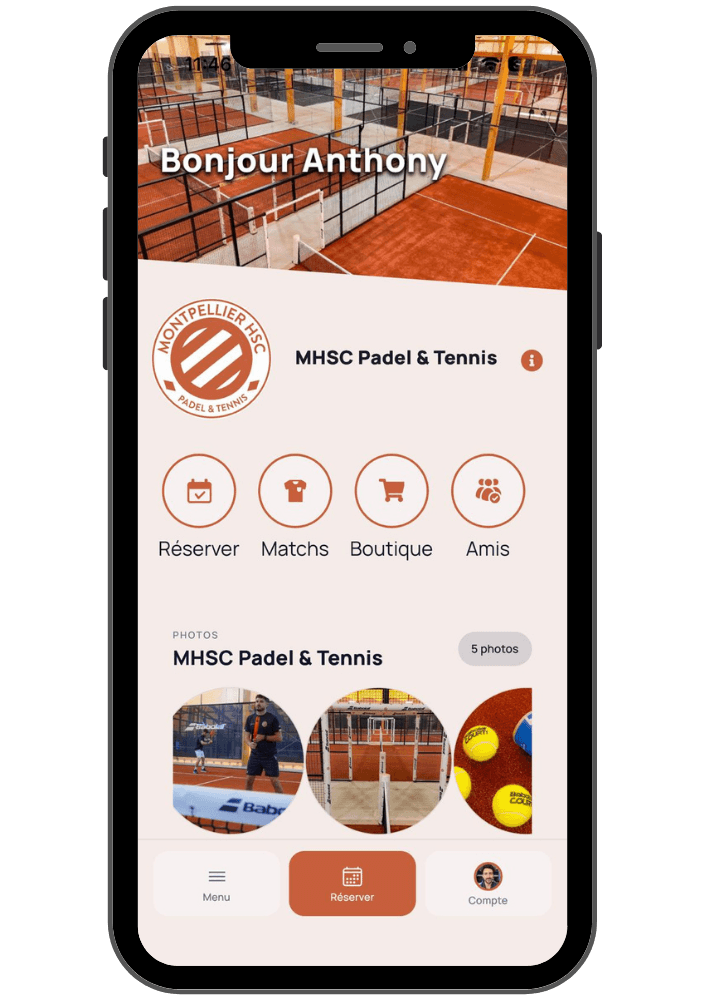
A custom-branded mobile app for your padel club allows players to book directly in an environment that features only your brand.
4. How much does a custom mobile app for a padel club cost?
Not all "booking apps" are created equal.
It is important to distinguish between:
A generic marketplace app
Multiple clubs are listed on the same platform.
Players interact primarily with the platform's brand, not yours.
A white-label, custom-branded app
The app is published under:
your club's name;
your logo;
your brand colors;
your news and updates;
your courts;
your online shop;
your offers and memberships.
It acts as a powerful player retention tool.
From your custom app, players can:
book courts;
pay securely;
use top-up credits;
buy memberships and packages;
register for tournaments and events;
receive targeted push notifications;
shop the pro shop.
The cost of a mobile app should not be evaluated as a mere technical expense.
Instead, ask yourself:
How much is a direct, distraction-free communication channel with thousands of active players worth to my business?
With every push notification or in-app offer, you are marketing directly to your own captive audience.
Learn how a custom-branded mobile app for padel clubs works.
5. POS software and hardware costs
Padel clubs rarely generate revenue from court bookings alone.
You likely also sell:
beverages and bar items;
food and snacks;
rackets and gear;
apparel;
grips and accessories;
balls;
memberships;
camps and clinics;
private lessons;
corporate events.
Your point of sale (POS) is a core component of your venue's operations.
When comparing software solutions, make sure to check:
if a POS module is included in the subscription;
if it complies with local fiscal regulations;
if it syncs in real-time with your court booking software;
if inventory management is automated;
if pro shop and bar sales are centralized under the same system;
if you need extra card terminals;
if POS hardware purchase or rental is billed separately.
A slightly more expensive software that seamlessly handles your front-of-house, pro shop, and court bookings is far more cost-effective than managing multiple disconnected tools.
6. How much does padel club automation cost?
For many modern clubs, software is just the foundation.
The right system can also automate the physical operations of your facility.
For example:
Online booking → automated payment → access code generation → door unlocks → court lights turn on.
This creates a fully seamless, self-service experience for players.
An automation project typically includes:
management software;
access control integrations;
smart locks;
QR code or RFID readers;
electrical wiring;
light controller integrations;
on-site installation;
any required peripheral hardware.
These projects are usually custom-scoped based on your venue's layout.
However, the upfront investment should be weighed against the operational savings and extra revenue they unlock.
Example
Imagine automation allows your club to stay open:
2 hours earlier + 2 hours later every single day.
That is 4 extra hours of booking availability daily, without the need to pay front-desk staff to cover those shifts.
Even at partial occupancy, these automated off-peak slots can significantly boost your bottom line.
Automation is an investment in revenue expansion, not just a line-item expense.
Explore our smart access control solutions for padel clubs and our dedicated offerings for autonomous padel courts.
7. Migration, onboarding, and training costs
This is arguably the most underestimated cost of switching software.
If your club is already running, moving to a new platform requires:
importing your player database;
migrating active memberships and packages;
configuring courts and schedules;
setting up pricing matrices;
connecting payment gateways;
customizing and launching your app;
training your staff;
notifying and transitioning your players.
Two systems with the exact same price tag will deliver a completely different return on experience if one leaves you to handle this complex migration entirely on your own.
Before you sign, make sure you get clear answers to these questions:
Who will configure my account?
Who will help clean up and migrate my existing database?
How is staff training handled?
What level of support do I get on launch day and beyond?
If you are already running on another platform, read our step-by-step guide:
Switching Padel Club Management Software: The Complete 2026 Guide.
The cheapest software is rarely the most cost-effective
This is perhaps the single most important takeaway of this guide.
Your software directly impacts a resource that never appears on a SaaS invoice:
your team's valuable time.
Let’s look at a simple example.
A club manager spends five hours a week on tasks that could easily be automated or streamlined:
manually verifying payments;
manually rescheduling bookings;
exporting and reconciling spreadsheets;
handling membership issues;
sending manual emails and announcements to players.
If we value their time at a modest $25 per hour,
the labor cost of those manual tasks is:
5 hours × $25 × 52 weeks = $6,500 per year.
Which translates to over:
$540 per month.
With this in mind, choosing a software platform just because it is $40 or $50 cheaper per month is a false economy if it drains hours of productive work from your staff every week.
How to calculate the true cost of your padel software
Use this simple formula:
True Annual Software Cost
Annual Subscription Fee
Add-ons and Optional Modules
Payment Processing Fees
Commissions / Variable Booking Fees
Hardware (POS, terminals, readers)
Ongoing Maintenance / Support Fees
Labor Cost of Manual Admin Tasks
=
Total Annual Cost of Ownership
But to make a truly informed decision, you need to go one step further.
You must subtract the financial and operational gains generated by the software:
staff hours saved;
eliminated unpaid court fees;
increased secondary spend (pro shop, bar);
optimized court occupancy rates;
extra bookings from expanded automated hours;
higher player retention;
seamless online retail revenue;
reduced overhead through automation.
This calculation will give you a clear, objective view of your true return on investment.
Example: Comparing two management solutions
Let’s compare options for a 6-court club.
Solution A
subscription: $150/month;
requires extra tools to manage retail and communication;
5 hours of manual admin tasks per week.
Solution B
subscription: $250/month;
all features centralized in one platform;
2 hours of manual admin tasks per week.
At first glance:
Solution A = $1,800/year
Solution B = $3,000/year
Solution A seems to save you $1,200 per year.
However, if we value the 3 hours of saved weekly labor at $25/hour:
3 hours × $25 × 52 weeks = $3,900 saved annually in labor costs.
In this scenario, Solution B is actually the more profitable choice, despite the higher subscription price.
While simplified, this example shows why the sticker price of software should never be your only buying metric.
What is the pricing for DoinSport in 2026?
DoinSport offers scalable plans tailored to your facility type and operational needs.
As of September 2026, our pricing starts at:
Clubs, Associations and Public Facilities
€99 / month on a month-to-month plan.
Or €89 / month billed annually.
Commercial Clubs
€179 / month on a month-to-month plan.
Or €161 / month billed annually.
Franchises and Multi-Site Operators
Custom enterprise quotes, tailored to the number of locations, custom integrations, and specific brand requirements.
Additional components like smart access control hardware, light controller boxes, and custom development are quoted individually.
Our goal is to build a configuration that perfectly matches your venue's needs, rather than charging you for features you do not use.
👉 View DoinSport Pricing Details
What is included in an all-in-one management platform?
When looking at software that costs $150, $200, or $300 a month, the price only makes sense when you understand what it replaces.
A comprehensive platform centralizes:
online court booking;
interactive court sheets;
membership management;
subscriptions and recurring billing;
digital wallets and player credits;
integrated payment processing;
POS system;
online pro shop;
customer communication tools;
advanced business analytics;
tournaments and match-making;
smart access control;
automated lighting integrations;
multi-location management.
This deep centralization is what makes an all-in-one platform a smart financial move.
Instead of juggling a messy software stack consisting of:
booking tool + standalone POS + email marketing software + manual spreadsheets + separate app + access control system
your entire club runs on a single database and a unified interface.
Discover the full feature set of the DoinSport padel club management platform.
Which software is right for your club's business model?
The ideal pricing structure and system depend heavily on your operations.
For new padel facilities
Your immediate priorities will be:
a fast, hassle-free setup;
easy booking and checkout workflows;
acquiring your first players;
keeping admin tasks to an absolute minimum.
Make sure to choose a partner that offers hands-on onboarding support.
For high-volume, established clubs
Your primary objectives shift toward:
eliminating variable commission costs;
building player loyalty directly to your brand;
automating repetitive workflows;
maximizing secondary spend (F&B, pro shop);
marketing effectively to your existing database.
At this stage, saving a few dollars on a monthly subscription is secondary to the massive ROI of operational efficiency.
For autonomous, 24/7 venues
You must budget for:
management software;
access control integrations;
lighting automation controllers;
hardware and installation costs.
But again, balance this upfront cost against the long-term savings of not needing staff on-site to open and run the venue.
For multi-site groups and franchises
The question is no longer just "how much does the software cost per club?".
It is about your ability to:
manage multiple locations from a single dashboard;
aggregate revenue and financial reporting;
compare performance across venues;
manage staff permissions centrally;
deliver a consistent player experience across the network;
consolidate customer data securely.
For enterprise operators, the business value of advanced reporting and centralized control far outweighs the cost of the software license.
10 questions to ask vendors before signing
Before committing to a padel club management solution, make sure to ask:
What is the total flat monthly or annual fee?
Exactly which features are included in this rate?
Which features or integrations require paid add-ons?
Does the price scale based on the number of courts I have?
Are there any hidden transaction or booking commission fees?
What are the exact processing rates for online payments?
Is a custom-branded mobile app included, or is it an extra charge?
What are the hardware and licensing costs for access control?
Is data migration, software setup, and staff training included?
How does the pricing scale as my business grows or as I add locations?
With these ten answers, you will be able to calculate a highly accurate annual cost of ownership.
If a vendor cannot give you clear answers on these points, ask for a more transparent breakdown before signing.
Sticker price vs. ROI: What is the ultimate metric?
The best software is not the one with the lowest monthly bill.
It is the one that delivers the highest ratio of value created relative to its cost.
A $100/month basic tool that only solves half your problems can end up costing you more than a $200/month comprehensive platform that successfully:
consolidates multiple separate tools;
automates daily tasks;
saves your staff hours of manual work;
streamlines player checkout and payments;
increases court occupancy and utilization;
boosts customer retention.
This is why we strongly recommend comparing solutions based on their annual value and total cost of ownership, rather than just the monthly subscription fee.
Which padel management software should you choose in 2026?
The market today offers several distinct approaches:
all-in-one club management systems;
basic online booking widgets;
consumer-facing marketplaces;
legacy sports club software;
highly specialized automation and hardware-first solutions.
The best choice depends entirely on your business goals and operational model.
If you are currently evaluating your options, check out our deep-dive analysis of the leading solutions on the market:
👉 Best Padel Club Management Software: 2026 Comparison
If you are currently using a system and considering making a change:
👉 The Complete Guide to Switching Padel Management Software
And if you are specifically looking at marketplace dependencies:
👉 Playtomic Alternatives: Which software should you choose?
What will DoinSport cost for your specific club?
The most accurate way to get a realistic price is to base it on your actual club setup:
number of courts;
number of locations;
your club's specific booking workflows;
expected booking volume;
payment processing needs;
mobile app custom branding;
POS hardware;
smart access control requirements;
automation features;
your long-term expansion plans.
You can check our transparent pricing page or book a quick, personalized demo to build a custom solution for your facility.
👉 Request a Personalized DoinSport Demo
FAQ — Padel Club Management Software Pricing
How much does padel club management software cost?
The cost varies depending on the type of platform, features selected, number of courts, and hardware integrations. To understand the true cost, you need to look beyond the subscription fee and factor in payment gateway rates, add-ons, hardware, setup costs, and any transaction fees.
What is the pricing for DoinSport?
As of September 2026, DoinSport plans for commercial clubs start at €179 per month (or €161 per month billed annually). Custom quotes are provided for advanced features, smart access control hardware, and automation integrations.
Are there commission fees on padel booking software?
This depends entirely on the provider. Some software companies charge a predictable flat subscription, while consumer marketplaces and other services may charge commission fees on bookings or transactions. Always ask for a complete cost projection based on your expected booking volume.
What extra costs should I plan for besides the software license?
Depending on your setup, you should budget for credit card processing fees, physical POS terminals, smart door locks, RFID/QR readers, automated court light controllers, and any custom onboarding or development services.
Is a mobile app included in the price of padel software?
This varies by provider and plan. It is important to distinguish between being listed on a shared, generic marketplace app and having a dedicated, custom-branded app published under your club’s own name on the App Store and Google Play.
What is the cheapest padel software?
The software with the lowest monthly subscription sticker price is rarely the cheapest option overall. You must account for variable transaction fees, the cost of adding essential third-party tools, and the labor cost of manual admin work when your team uses a limited system.
How do I compare pricing between two padel software systems?
Calculate the total annual cost of ownership (subscription, add-ons, payment processing, variable fees, and hardware). Then, evaluate this cost against the business value the solution generates through staff time saved, increased bookings, and better player retention.
Is it worth paying for management software if I have a small club?
Yes, even with just a few courts, the right software can easily pay for itself by automating time-consuming admin work, securing online bookings, and allowing for staff-free or self-service operating hours. Business profitability is driven by smart resource utilization, not just court volume.
Can I switch software without losing my players or membership data?
Yes. Depending on the import/export capabilities of both systems, most of your player profiles, historical data, and active memberships can be successfully migrated. It is important to plan this data transition carefully before canceling your current system. Check out our complete software migration guide.
How can I get a custom quote from DoinSport for my venue?
You can view our base rates on the DoinSport pricing page or book a personalized product demo. Our team will help configure a tailored solution based on your courts, features, and hardware needs.
Summary
To find the true cost of padel club management software, never look at the monthly subscription fee in isolation.
Always calculate:
subscription + payment processing + variable fees + add-ons + hardware + admin labor.
Then, compare that total cost against the business value and ROI the platform delivers:
time saved + automated operations + extra bookings + higher retention + increased revenue.
This complete picture is the only way to determine which management solution is the most profitable choice for your club.
Want to see what DoinSport would cost for your specific venue?
How much does it actually cost to equip a padel club with management software?
The answer is less straightforward than a simple monthly price tag.
Between the software subscription, online payment fees, potential commissions, mobile app, POS system, access control, hardware, and the time spent by your team, two solutions with a similar price tag can actually end up having vastly different costs.
For a padel club, the monthly software fee is therefore not the only metric you should look at.
You need to consider its total cost of ownership, also known as TCO, as well as the revenue and efficiency gains it generates: saved admin time, additional bookings, automation, and player loyalty.
In this guide, we will break down the main costs to keep in mind for 2026 and give you a simple framework to compare different management software options objectively.
Still comparing the different solutions on the market? Check out our comparison of the best padel club management software in 2026.
How much does padel club management software cost?
There is no single pricing plan that fits all clubs.
The price mainly depends on:
the number of courts;
the number of locations;
the features you use;
whether you want a custom-branded mobile app;
the POS system;
online payments;
access control;
automated court lighting;
the level of onboarding and customer support;
the specific needs of your club.
Software providers also use different pricing models.
Flat-rate monthly subscription
This is the most straightforward model to understand.
The club pays a fixed monthly subscription to access the software and the features included in their plan.
The main benefit is budget predictability.
If your bookings and revenue grow significantly, your software costs do not necessarily increase at the same pace.
Structure-based pricing
Some solutions scale their pricing based on:
the number of courts;
the number of clubs;
the number of users;
activated features;
the type of facility.
Naturally, a small community club does not have the same requirements as a franchise network operating fifteen locations.
Add-ons and options
An entry-level price might only cover basic features.
Other modules may be billed separately:
POS system;
custom-branded app;
access control;
automated lighting;
website creation;
payment terminals;
advanced analytics and reporting;
multi-site management features.
It is therefore crucial to compare what is actually included in your specific configuration.
Transaction or booking fees
Finally, some platforms and providers charge fees based on your business volume:
payment processing fees;
commissions;
service fees;
per-booking fees;
fees charged to either the club or the player.
This model can seem cost-effective when a club first opens.
However, as booking volumes grow, it is essential to calculate the real financial impact.
The 7 key costs to compare before choosing a padel software
To accurately compare two solutions, ask for a detailed quote covering these seven key areas.
1. The software subscription
This is the most visible part.
Your management software should ideally cover all essential club operations:
scheduling and court sheets;
bookings and reservations;
membership management;
subscriptions;
payments;
customer communication;
reporting and analytics.
An all-in-one platform might have a slightly higher subscription fee but will replace several single-use tools that you currently pay for separately.
That is why comparing monthly subscriptions alone rarely gives you a clear picture of the actual cost.
To understand what an all-in-one tool can centralize, discover our padel club management software.
2. Online payment processing fees
These are often overlooked during the buying process.
Yet, as soon as a player books and pays online via your website or app, a payment gateway handles the transaction.
These fees typically depend on:
the transaction volume;
the card type (debit, credit, premium);
the card's country of origin;
the payment method;
the payment gateway provider.
With DoinSport, online payments can be centralized via Stripe for court bookings, memberships, and pro shop purchases.
The goal is not to find a "zero fee" system, but rather to understand:
How much does it actually cost me to process $100 in revenue?
And, more importantly, to balance this cost against the benefits of online payments:
fewer unpaid balances and no-shows;
instant booking confirmations;
fewer manual admin tasks;
split payments among players;
recurring revenue through automated subscriptions.
To learn more, check out our online payment solutions for padel clubs.
3. Commissions and booking fees
This is a critical factor for clubs with high occupancy rates.
Let’s look at a hypothetical club with:
6 courts;
6 bookings per court per day;
an average booking value of $30;
30 days of operation per month.
The monthly booking revenue would be around:
6 courts × 6 bookings × 30 days × $30 = $32,400 per month.
With this level of activity, a seemingly small difference in variable fees can quickly add up to a significant amount over the year.
For instance, a 1% fee on $32,400 represents $324 per month, or $3,888 per year.
At 2%, the impact climbs to:
$648 per month, or $7,776 per year.
This does not mean a commission-based model is always a bad choice.
A marketplace platform that actively brings new players to your club can justify part of this cost.
However, you must distinguish between two things:
the cost of acquiring new players
and
the fees applied to players who would have booked with you anyway.
To understand the difference between SaaS management software and consumer marketplaces, read our guide: Playtomic Alternative: Which management software should you choose for your padel club?.
Flat-rate subscription vs. Commission: Which model is more profitable?
There is no one-size-fits-all answer.
It all depends on your club's stage of growth.
For a brand-new club
A consumer marketplace can be highly beneficial if it helps solve your primary challenge:
finding players and filling empty courts.
In this scenario, commission fees can be considered a marketing and acquisition cost.
For an established club
The equation changes when you already have:
a solid base of active members;
a strong local community;
a high court occupancy rate;
a recognized local brand;
thousands of recurring bookings.
At this stage, variable commission fees become a heavy burden.
As your revenue grows, it becomes critical to calculate:
Software Cost / Revenue generated from bookings
and
Variable fees / Total processed revenue.
A mature club will also want to own its customer relationships directly, rather than funneling players to a third-party marketplace app where competitors are also listed.
A custom-branded mobile app for your padel club allows players to book directly in an environment that features only your brand.
4. How much does a custom mobile app for a padel club cost?
Not all "booking apps" are created equal.
It is important to distinguish between:
A generic marketplace app
Multiple clubs are listed on the same platform.
Players interact primarily with the platform's brand, not yours.
A white-label, custom-branded app
The app is published under:
your club's name;
your logo;
your brand colors;
your news and updates;
your courts;
your online shop;
your offers and memberships.
It acts as a powerful player retention tool.
From your custom app, players can:
book courts;
pay securely;
use top-up credits;
buy memberships and packages;
register for tournaments and events;
receive targeted push notifications;
shop the pro shop.
The cost of a mobile app should not be evaluated as a mere technical expense.
Instead, ask yourself:
How much is a direct, distraction-free communication channel with thousands of active players worth to my business?
With every push notification or in-app offer, you are marketing directly to your own captive audience.
Learn how a custom-branded mobile app for padel clubs works.
5. POS software and hardware costs
Padel clubs rarely generate revenue from court bookings alone.
You likely also sell:
beverages and bar items;
food and snacks;
rackets and gear;
apparel;
grips and accessories;
balls;
memberships;
camps and clinics;
private lessons;
corporate events.
Your point of sale (POS) is a core component of your venue's operations.
When comparing software solutions, make sure to check:
if a POS module is included in the subscription;
if it complies with local fiscal regulations;
if it syncs in real-time with your court booking software;
if inventory management is automated;
if pro shop and bar sales are centralized under the same system;
if you need extra card terminals;
if POS hardware purchase or rental is billed separately.
A slightly more expensive software that seamlessly handles your front-of-house, pro shop, and court bookings is far more cost-effective than managing multiple disconnected tools.
6. How much does padel club automation cost?
For many modern clubs, software is just the foundation.
The right system can also automate the physical operations of your facility.
For example:
Online booking → automated payment → access code generation → door unlocks → court lights turn on.
This creates a fully seamless, self-service experience for players.
An automation project typically includes:
management software;
access control integrations;
smart locks;
QR code or RFID readers;
electrical wiring;
light controller integrations;
on-site installation;
any required peripheral hardware.
These projects are usually custom-scoped based on your venue's layout.
However, the upfront investment should be weighed against the operational savings and extra revenue they unlock.
Example
Imagine automation allows your club to stay open:
2 hours earlier + 2 hours later every single day.
That is 4 extra hours of booking availability daily, without the need to pay front-desk staff to cover those shifts.
Even at partial occupancy, these automated off-peak slots can significantly boost your bottom line.
Automation is an investment in revenue expansion, not just a line-item expense.
Explore our smart access control solutions for padel clubs and our dedicated offerings for autonomous padel courts.
7. Migration, onboarding, and training costs
This is arguably the most underestimated cost of switching software.
If your club is already running, moving to a new platform requires:
importing your player database;
migrating active memberships and packages;
configuring courts and schedules;
setting up pricing matrices;
connecting payment gateways;
customizing and launching your app;
training your staff;
notifying and transitioning your players.
Two systems with the exact same price tag will deliver a completely different return on experience if one leaves you to handle this complex migration entirely on your own.
Before you sign, make sure you get clear answers to these questions:
Who will configure my account?
Who will help clean up and migrate my existing database?
How is staff training handled?
What level of support do I get on launch day and beyond?
If you are already running on another platform, read our step-by-step guide:
Switching Padel Club Management Software: The Complete 2026 Guide.
The cheapest software is rarely the most cost-effective
This is perhaps the single most important takeaway of this guide.
Your software directly impacts a resource that never appears on a SaaS invoice:
your team's valuable time.
Let’s look at a simple example.
A club manager spends five hours a week on tasks that could easily be automated or streamlined:
manually verifying payments;
manually rescheduling bookings;
exporting and reconciling spreadsheets;
handling membership issues;
sending manual emails and announcements to players.
If we value their time at a modest $25 per hour,
the labor cost of those manual tasks is:
5 hours × $25 × 52 weeks = $6,500 per year.
Which translates to over:
$540 per month.
With this in mind, choosing a software platform just because it is $40 or $50 cheaper per month is a false economy if it drains hours of productive work from your staff every week.
How to calculate the true cost of your padel software
Use this simple formula:
True Annual Software Cost
Annual Subscription Fee
Add-ons and Optional Modules
Payment Processing Fees
Commissions / Variable Booking Fees
Hardware (POS, terminals, readers)
Ongoing Maintenance / Support Fees
Labor Cost of Manual Admin Tasks
=
Total Annual Cost of Ownership
But to make a truly informed decision, you need to go one step further.
You must subtract the financial and operational gains generated by the software:
staff hours saved;
eliminated unpaid court fees;
increased secondary spend (pro shop, bar);
optimized court occupancy rates;
extra bookings from expanded automated hours;
higher player retention;
seamless online retail revenue;
reduced overhead through automation.
This calculation will give you a clear, objective view of your true return on investment.
Example: Comparing two management solutions
Let’s compare options for a 6-court club.
Solution A
subscription: $150/month;
requires extra tools to manage retail and communication;
5 hours of manual admin tasks per week.
Solution B
subscription: $250/month;
all features centralized in one platform;
2 hours of manual admin tasks per week.
At first glance:
Solution A = $1,800/year
Solution B = $3,000/year
Solution A seems to save you $1,200 per year.
However, if we value the 3 hours of saved weekly labor at $25/hour:
3 hours × $25 × 52 weeks = $3,900 saved annually in labor costs.
In this scenario, Solution B is actually the more profitable choice, despite the higher subscription price.
While simplified, this example shows why the sticker price of software should never be your only buying metric.
What is the pricing for DoinSport in 2026?
DoinSport offers scalable plans tailored to your facility type and operational needs.
As of September 2026, our pricing starts at:
Clubs, Associations and Public Facilities
€99 / month on a month-to-month plan.
Or €89 / month billed annually.
Commercial Clubs
€179 / month on a month-to-month plan.
Or €161 / month billed annually.
Franchises and Multi-Site Operators
Custom enterprise quotes, tailored to the number of locations, custom integrations, and specific brand requirements.
Additional components like smart access control hardware, light controller boxes, and custom development are quoted individually.
Our goal is to build a configuration that perfectly matches your venue's needs, rather than charging you for features you do not use.
👉 View DoinSport Pricing Details
What is included in an all-in-one management platform?
When looking at software that costs $150, $200, or $300 a month, the price only makes sense when you understand what it replaces.
A comprehensive platform centralizes:
online court booking;
interactive court sheets;
membership management;
subscriptions and recurring billing;
digital wallets and player credits;
integrated payment processing;
POS system;
online pro shop;
customer communication tools;
advanced business analytics;
tournaments and match-making;
smart access control;
automated lighting integrations;
multi-location management.
This deep centralization is what makes an all-in-one platform a smart financial move.
Instead of juggling a messy software stack consisting of:
booking tool + standalone POS + email marketing software + manual spreadsheets + separate app + access control system
your entire club runs on a single database and a unified interface.
Discover the full feature set of the DoinSport padel club management platform.
Which software is right for your club's business model?
The ideal pricing structure and system depend heavily on your operations.
For new padel facilities
Your immediate priorities will be:
a fast, hassle-free setup;
easy booking and checkout workflows;
acquiring your first players;
keeping admin tasks to an absolute minimum.
Make sure to choose a partner that offers hands-on onboarding support.
For high-volume, established clubs
Your primary objectives shift toward:
eliminating variable commission costs;
building player loyalty directly to your brand;
automating repetitive workflows;
maximizing secondary spend (F&B, pro shop);
marketing effectively to your existing database.
At this stage, saving a few dollars on a monthly subscription is secondary to the massive ROI of operational efficiency.
For autonomous, 24/7 venues
You must budget for:
management software;
access control integrations;
lighting automation controllers;
hardware and installation costs.
But again, balance this upfront cost against the long-term savings of not needing staff on-site to open and run the venue.
For multi-site groups and franchises
The question is no longer just "how much does the software cost per club?".
It is about your ability to:
manage multiple locations from a single dashboard;
aggregate revenue and financial reporting;
compare performance across venues;
manage staff permissions centrally;
deliver a consistent player experience across the network;
consolidate customer data securely.
For enterprise operators, the business value of advanced reporting and centralized control far outweighs the cost of the software license.
10 questions to ask vendors before signing
Before committing to a padel club management solution, make sure to ask:
What is the total flat monthly or annual fee?
Exactly which features are included in this rate?
Which features or integrations require paid add-ons?
Does the price scale based on the number of courts I have?
Are there any hidden transaction or booking commission fees?
What are the exact processing rates for online payments?
Is a custom-branded mobile app included, or is it an extra charge?
What are the hardware and licensing costs for access control?
Is data migration, software setup, and staff training included?
How does the pricing scale as my business grows or as I add locations?
With these ten answers, you will be able to calculate a highly accurate annual cost of ownership.
If a vendor cannot give you clear answers on these points, ask for a more transparent breakdown before signing.
Sticker price vs. ROI: What is the ultimate metric?
The best software is not the one with the lowest monthly bill.
It is the one that delivers the highest ratio of value created relative to its cost.
A $100/month basic tool that only solves half your problems can end up costing you more than a $200/month comprehensive platform that successfully:
consolidates multiple separate tools;
automates daily tasks;
saves your staff hours of manual work;
streamlines player checkout and payments;
increases court occupancy and utilization;
boosts customer retention.
This is why we strongly recommend comparing solutions based on their annual value and total cost of ownership, rather than just the monthly subscription fee.
Which padel management software should you choose in 2026?
The market today offers several distinct approaches:
all-in-one club management systems;
basic online booking widgets;
consumer-facing marketplaces;
legacy sports club software;
highly specialized automation and hardware-first solutions.
The best choice depends entirely on your business goals and operational model.
If you are currently evaluating your options, check out our deep-dive analysis of the leading solutions on the market:
👉 Best Padel Club Management Software: 2026 Comparison
If you are currently using a system and considering making a change:
👉 The Complete Guide to Switching Padel Management Software
And if you are specifically looking at marketplace dependencies:
👉 Playtomic Alternatives: Which software should you choose?
What will DoinSport cost for your specific club?
The most accurate way to get a realistic price is to base it on your actual club setup:
number of courts;
number of locations;
your club's specific booking workflows;
expected booking volume;
payment processing needs;
mobile app custom branding;
POS hardware;
smart access control requirements;
automation features;
your long-term expansion plans.
You can check our transparent pricing page or book a quick, personalized demo to build a custom solution for your facility.
👉 Request a Personalized DoinSport Demo
FAQ — Padel Club Management Software Pricing
How much does padel club management software cost?
The cost varies depending on the type of platform, features selected, number of courts, and hardware integrations. To understand the true cost, you need to look beyond the subscription fee and factor in payment gateway rates, add-ons, hardware, setup costs, and any transaction fees.
What is the pricing for DoinSport?
As of September 2026, DoinSport plans for commercial clubs start at €179 per month (or €161 per month billed annually). Custom quotes are provided for advanced features, smart access control hardware, and automation integrations.
Are there commission fees on padel booking software?
This depends entirely on the provider. Some software companies charge a predictable flat subscription, while consumer marketplaces and other services may charge commission fees on bookings or transactions. Always ask for a complete cost projection based on your expected booking volume.
What extra costs should I plan for besides the software license?
Depending on your setup, you should budget for credit card processing fees, physical POS terminals, smart door locks, RFID/QR readers, automated court light controllers, and any custom onboarding or development services.
Is a mobile app included in the price of padel software?
This varies by provider and plan. It is important to distinguish between being listed on a shared, generic marketplace app and having a dedicated, custom-branded app published under your club’s own name on the App Store and Google Play.
What is the cheapest padel software?
The software with the lowest monthly subscription sticker price is rarely the cheapest option overall. You must account for variable transaction fees, the cost of adding essential third-party tools, and the labor cost of manual admin work when your team uses a limited system.
How do I compare pricing between two padel software systems?
Calculate the total annual cost of ownership (subscription, add-ons, payment processing, variable fees, and hardware). Then, evaluate this cost against the business value the solution generates through staff time saved, increased bookings, and better player retention.
Is it worth paying for management software if I have a small club?
Yes, even with just a few courts, the right software can easily pay for itself by automating time-consuming admin work, securing online bookings, and allowing for staff-free or self-service operating hours. Business profitability is driven by smart resource utilization, not just court volume.
Can I switch software without losing my players or membership data?
Yes. Depending on the import/export capabilities of both systems, most of your player profiles, historical data, and active memberships can be successfully migrated. It is important to plan this data transition carefully before canceling your current system. Check out our complete software migration guide.
How can I get a custom quote from DoinSport for my venue?
You can view our base rates on the DoinSport pricing page or book a personalized product demo. Our team will help configure a tailored solution based on your courts, features, and hardware needs.
Summary
To find the true cost of padel club management software, never look at the monthly subscription fee in isolation.
Always calculate:
subscription + payment processing + variable fees + add-ons + hardware + admin labor.
Then, compare that total cost against the business value and ROI the platform delivers:
time saved + automated operations + extra bookings + higher retention + increased revenue.
This complete picture is the only way to determine which management solution is the most profitable choice for your club.
Want to see what DoinSport would cost for your specific venue?
Similar articles
Take your club to the next level
Ready to transform your padel, tennis, and country club?
Join the +1,000 clubs that trust Doinsport. Get started in less than 30 minutes and see the difference from the very first day.
We are here to support you.


Take your club to the next level
Ready to transform your padel, tennis, and country club?
Join the +1,000 clubs that trust Doinsport. Get started in less than 30 minutes and see the difference from the very first day.


Take your club to the next level
Ready to transform your padel, tennis, and country club?
Join the +1,000 clubs that trust Doinsport. Get started in less than 30 minutes and see the difference from the very first day.
We are here to support you.


